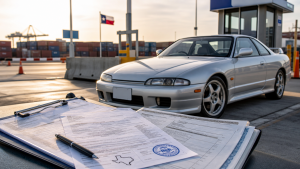

Phase 1 refunds for IEEPA reciprocal tariffs are live as of April 20, 2026. CBP launched the CAPE tool (Consolidated Administration and Processing of Entries) in the ACE Secure Data Portal to handle refund claims electronically — no traditional protest filing required.
This guide covers the full process from a customs broker’s perspective — what to prepare, how CAPE works, and where claims can get complicated.
Step 1: Identify Your Qualifying Entries
Every formal import entry has an entry number — an 11-digit identifier assigned by CBP when your broker filed the entry summary (CBP Form 7501). This number is your starting point.
Pull your entry numbers from:
- Your customs broker’s records (AWIS can pull these if we handled your clearance)
- Your commercial invoices or broker invoices showing duties paid
- CBP’s ACE Portal if you have your own importer login
For the Phase 1 window (March 22, 2025 – February 24, 2026), you need entries that:
- Were subject to IEEPA reciprocal tariffs specifically — not just Section 301 (China) or Section 232 (steel/aluminum)
- Were formally entered (informal entries under $800 generally weren’t subject to these tariffs)
- Have been liquidated — CBP has finalized the duty assessment
If an entry is unliquidated, CBP may administratively process it under the court’s ruling without a protest. Check with your broker on current guidance.
Step 2: Confirm Which Tariff Codes Are Affected
Not every import entry paid IEEPA tariffs. The reciprocal tariff orders targeted specific HTS (Harmonized Tariff Schedule) codes and countries of origin. For vehicle imports, the most commonly affected codes:
- HTS 8703.xx.xx — passenger vehicles (including JDM imports)
- HTS 8704.xx.xx — trucks, light commercial vehicles
- HTS 8711.xx.xx — motorcycles (some country/date combinations)
- HTS 8716.xx.xx — trailers and semi-trailers (commercial)
Country of origin matters. Vehicles from Japan, South Korea, Germany, the UK, and Australia were among those hit by reciprocal tariffs at varying rates. Vehicles from Canada and Mexico were not subject to IEEPA reciprocal tariffs (separate USMCA/Section 232 frameworks apply).
Your entry’s rate of duty breakdown will show the IEEPA component separately if your broker coded it correctly. If it wasn’t broken out, we may need to reconstruct it from the original tariff schedule.
Step 3: Calculate the Refund Amount
The refund is the IEEPA tariff component only — not other duties that remain valid (Section 301, MFN rates, Section 232). This is where the math gets important.
Example: A Japanese vehicle entered under HTS 8703.23.01 in September 2025 might have been assessed:
- 2.5% MFN duty (this is a permanent rate, not refundable)
- 25% IEEPA reciprocal tariff (this is what’s being refunded)
On a $30,000 vehicle, that’s $7,500 in IEEPA tariffs potentially refundable. The 2.5% MFN duty ($750) stays.
For older JDM vehicles entered under the 25-year exemption (which exempts them from EPA/DOT compliance, not duty), the customs value and applicable duties are different — but the same IEEPA component logic applies.
Step 4: File Through the CAPE Tool in ACE
CBP created a new electronic pathway specifically for IEEPA refunds — the CAPE tool (Consolidated Administration and Processing of Entries). This is not a traditional protest. It is a streamlined refund process that consolidates claims rather than processing them entry by entry.
Who files: The Importer of Record (IOR) or their authorized customs broker through the ACE Secure Data Portal.
How it works:
- The IOR or authorized broker submits a CAPE Declaration in the ACE Portal
- Once accepted, CBP removes the IEEPA HTS number from the entry and recalculates duties without the IEEPA component
- CBP reviews the updated entry version and liquidates or reliquidates
- Refunds are consolidated by IOR (or designated party via CBP Form 4811) and liquidation date
Phase 1 scope: Currently limited to certain unliquidated entries and entries within 80 days of liquidation. More complicated scenarios will be covered in later CAPE phases.
What you need before filing:
- An established ACE Secure Data Portal account
- Bank account information for refunds added to your ACE account (ACH enrollment)
- Entry data showing IEEPA tariff components
POA requirements: If AWIS is filing on your behalf, we need an active Power of Attorney on file. If you don’t have one with us, we’ll send you a digital POA form — it takes about five minutes.
Questions? CBP directs technical questions to IEEPARefunds@cbp.dhs.gov and general questions to traderelations@cbp.dhs.gov.
Step 5: Track the CAPE Declaration and Respond to CBP
Once your CAPE Declaration is accepted, CBP processes the entry recalculation. Refunds are consolidated — meaning CBP batches refunds by IOR and liquidation date rather than cutting a check per entry. This should be faster than the traditional protest route.
CBP may still request additional information during review. Respond promptly to avoid delays.
For entries that fall outside Phase 1 scope (already liquidated beyond 80 days, or with complications), CBP says additional CAPE phases will add functionality for those scenarios. We are tracking this closely.
Step 6: Receive the Refund
Approved refunds are issued as Treasury checks or electronic payments to the importer of record. The refund covers the duty paid plus statutory interest (currently around 6% per annum from the date of payment).
If your broker paid the duties on your behalf and you reimbursed them, coordinate with your broker on how the refund flows back to you.
Common Complications to Watch For
Multiple duty components. If your entry had both IEEPA and Section 301 tariffs, the protest needs to clearly delineate what you’re claiming. Overstating the claim creates problems.
Country of origin issues. If the origin declaration on the entry was incorrect or disputed, that affects which tariff applied and whether the refund applies.
Already-denied liquidations. If CBP previously denied a classification that affected the tariff rate, that’s a separate matter from the IEEPA refund and needs separate treatment.
Phase 1 limitations. CAPE Phase 1 only covers certain unliquidated entries and entries within 80 days of liquidation. If your entries liquidated more than 80 days ago, you may need to wait for a later CAPE phase or pursue a traditional protest. Know your liquidation dates.
ACE Portal access. If you don’t have an ACE Portal account, set one up now. Enroll in ACH refunds so CBP can pay you electronically when the claim is approved.
—
Let AWIS Handle the Filing
If your entries are in our system, we can identify qualifying imports, calculate the IEEPA components, prepare the protest documentation, and file through ACE on your behalf. This is what we do.
Contact AWIS:
📞 (817) 795-2947
Or start at awis.us — reach out through the contact form and mention IEEPA protest. We’ll pull your records and tell you within 24 hours what you’re looking at.
Time limits are real. If your entries liquidated in fall 2025, you may have weeks, not months. Don’t wait.