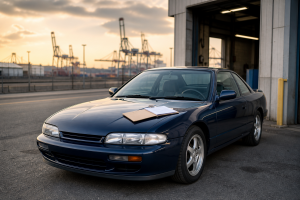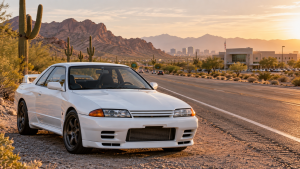
The 25-year rule has unlocked 2001 model year Japanese domestic market vehicles for US import. The Nissan Silvia S15, Toyota Altezza RS200, Mitsubishi Lancer Evo VII, Subaru WRX STI, and Honda Integra Type R DC5 are all now eligible. If you’re planning to import one, here’s what the customs clearance process looks like — step by step, with the specific documentation CBP requires.
Why the 25-Year Exemption Matters for Customs
US Federal Motor Vehicle Safety Standards (FMVSS) require that imported vehicles meet specific safety specifications before they can be registered and driven on US roads. JDM vehicles were built to Japanese standards, not US ones. That normally means modifications, testing, and DOT bonding — a time-consuming and expensive process.
The 25-year exemption carves out an exception: vehicles 25 years old or older can be imported without FMVSS compliance because they’re classified as antique or collector vehicles. A separate EPA exemption applies as well.
Understanding this matters for customs because your entry must correctly declare the exemption. Getting this wrong on the entry summary doesn’t mean CBP will reject your vehicle — but it can create delays, additional questions, and complications at liquidation.
Importer Security Filing (ISF): File It Before the Ship Arrives
For any ocean import, the Importer Security Filing (ISF) — also called 10+2 — must be filed at least 72 hours before the vessel departs the last foreign port. For Japan to US West Coast shipments, that means the ISF goes in before the ship leaves Osaka, Nagoya, or Yokohama.
The ISF requires:
- Seller name and address (the Japanese exporter or auction house)
- Buyer name and address (you, the importer)
- Importer of Record (IoR) number — your EIN or Social Security Number
- Consignee information
- Manufacturer or supplier name/address
- Country of origin: Japan
- HTS classification (preliminary — you have up to 24 hours before arrival to update)
- Container stuffing location and consolidator information (for container shipments; N/A for RoRo)
For RoRo shipments (vehicle drives on/off the vessel), some ISF elements work differently. AWIS handles ISF filing as part of the clearance package — you don’t need to worry about the mechanics, but you need to provide the documentation that feeds it.
ISF penalty: CBP can assess $5,000 per violation for late, inaccurate, or missing ISF filings. We file ISF as soon as we have the vessel booking confirmation. Don’t wait.
HTS Classification for JDM Vehicles
For CBP purposes, a JDM car is classified the same as any other passenger vehicle. The primary classification codes:
- 8703.22.01 — passenger vehicles with spark-ignition engines over 1,000cc but not over 1,500cc (some Kei-class engines)
- 8703.23.01 — passenger vehicles with spark-ignition engines over 1,500cc but not over 3,000cc (Silvia S15 SR20DET, Altezza 3S-GE, most common)
- 8703.24.01 — passenger vehicles with spark-ignition engines over 3,000cc (less common for JDM sports cars of this era)
The base MFN (Most Favored Nation) duty rate for most passenger vehicles from Japan is 2.5% on the transaction value (the price you paid, or the customs value if CBP questions the declared value).
Note on IEEPA tariffs: The current guidance from CBP is that 25-year-old vehicles imported under the antique exemption are not subject to the IEEPA reciprocal tariff regime that applied to commercial vehicle imports in 2025-2026. Verify this with your broker at time of import — tariff guidance changes, and you want current confirmation, not 6-month-old information.
The 25-Year DOT Exemption: HS-7 Declaration
CBP coordinates with the National Highway Traffic Safety Administration (NHTSA) on vehicle imports. When you import a 25-year-old vehicle, you file a HS-7 Declaration — this is the NHTSA form that declares the vehicle’s compliance status.
For a 25-year vehicle, you’ll check Box 8 on the HS-7: “This vehicle is 25 years old or older and is not subject to Federal Motor Vehicle Safety Standards.”
The vehicle’s manufacture date (not model year) is what CBP and NHTSA look at. Your Japanese title and the VIN decode should confirm the actual production date. For 2001 model year vehicles, production typically ran calendar year 2000-2001. If CBP questions whether the vehicle was actually manufactured in 2001 or earlier, the Japanese export certificate and build sheet (if available) support your declaration.
EPA Exemption for 25-Year Vehicles
The Environmental Protection Agency has a parallel exemption. Vehicles 21 years or older are exempt from EPA emission standards for import purposes. Since 2001 vehicles easily clear that threshold, you’ll simply declare the EPA exemption on the EPA form filed with CBP.
This is separate from state emission requirements. California applies its own rules to JDM imports even when federally exempt. If you’re registering in California, discuss this with your broker and a California DMV specialist before the vehicle arrives — options exist but they require additional steps.
Customs Entry Process: What Happens at Port
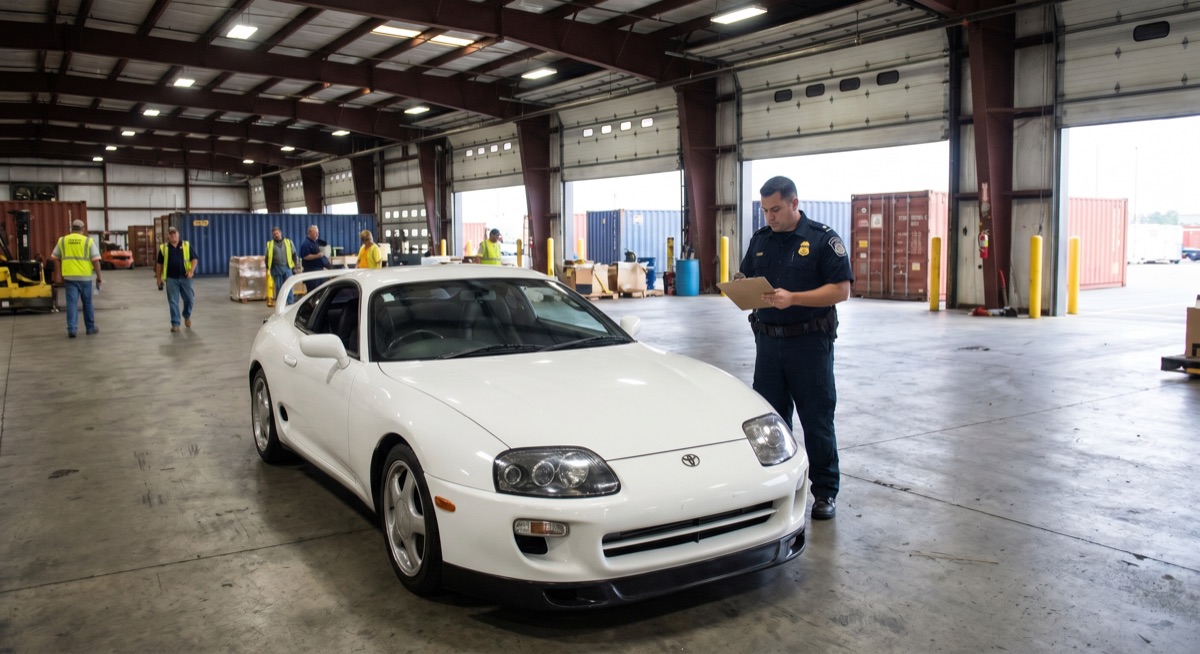
When your vehicle arrives at a US port (Los Angeles/Long Beach, Seattle, Baltimore, Jacksonville, or others), here’s what happens:
1. Arrival and exam selection. CBP may select the vehicle for physical exam (VACIS scan or full inspection) or release it based on the paperwork. Exam selection is partly random, partly risk-based. JDM imports don’t have a higher exam rate than other vehicles, but clean documentation reduces the chance of holds.
2. Formal entry filing. AWIS files the CBP Entry Summary (Form 7501) through the Automated Broker Interface (ABI). This includes the HTS classification, declared value, duties calculation, and all exemption declarations (HS-7, EPA).
3. Duty payment. The 2.5% MFN duty is due at entry. For a vehicle with a customs value of $20,000, that’s $500. CBP requires a bond to cover duties — either a single-entry bond (purchased for this import specifically) or a continuous bond if you’re a regular importer. AWIS arranges the bond as part of the clearance process.
4. Release and delivery. Once CBP releases the vehicle (typically 1-3 business days for a clean entry), TGAL or a drayage provider picks it up from the port and delivers it to you.
Power of Attorney
If you want AWIS to handle the clearance on your behalf, you need to sign a Power of Attorney authorizing us to act as your customs broker. We’ll send you the form digitally — it’s one page, takes five minutes. The POA stays on file with us for all future imports you do through AWIS.
Documents to Gather Before the Vehicle Ships
Start pulling these together as soon as you confirm your purchase:
- Japanese vehicle title (jidosha jūken shōmei)
- Export certificate from Japan
- Purchase invoice showing transaction value
- Bill of sale or auction record
- Vessel booking confirmation (once arranged)
- Your government-issued ID
- Your EIN or SSN (for Importer of Record)
The cleaner your documentation, the faster the clearance. Gaps in documentation don’t stop the import, but they create delays and CBP inquiries that extend the process.
—
Let AWIS Clear Your JDM Import
We handle JDM imports regularly, including the ISF filing, formal entry, HS-7 and EPA declarations, duty payment coordination, and bond arrangements. We know the 25-year exemption process and have current guidance on applicable tariff rates.
Contact AWIS:
📞 (817) 795-2947
Or start at awis.us — reach out through the contact page with the vehicle details and expected arrival port. We’ll confirm the process and what to prepare.