Welcome to the next article in AWIS’ JDM state registration series.
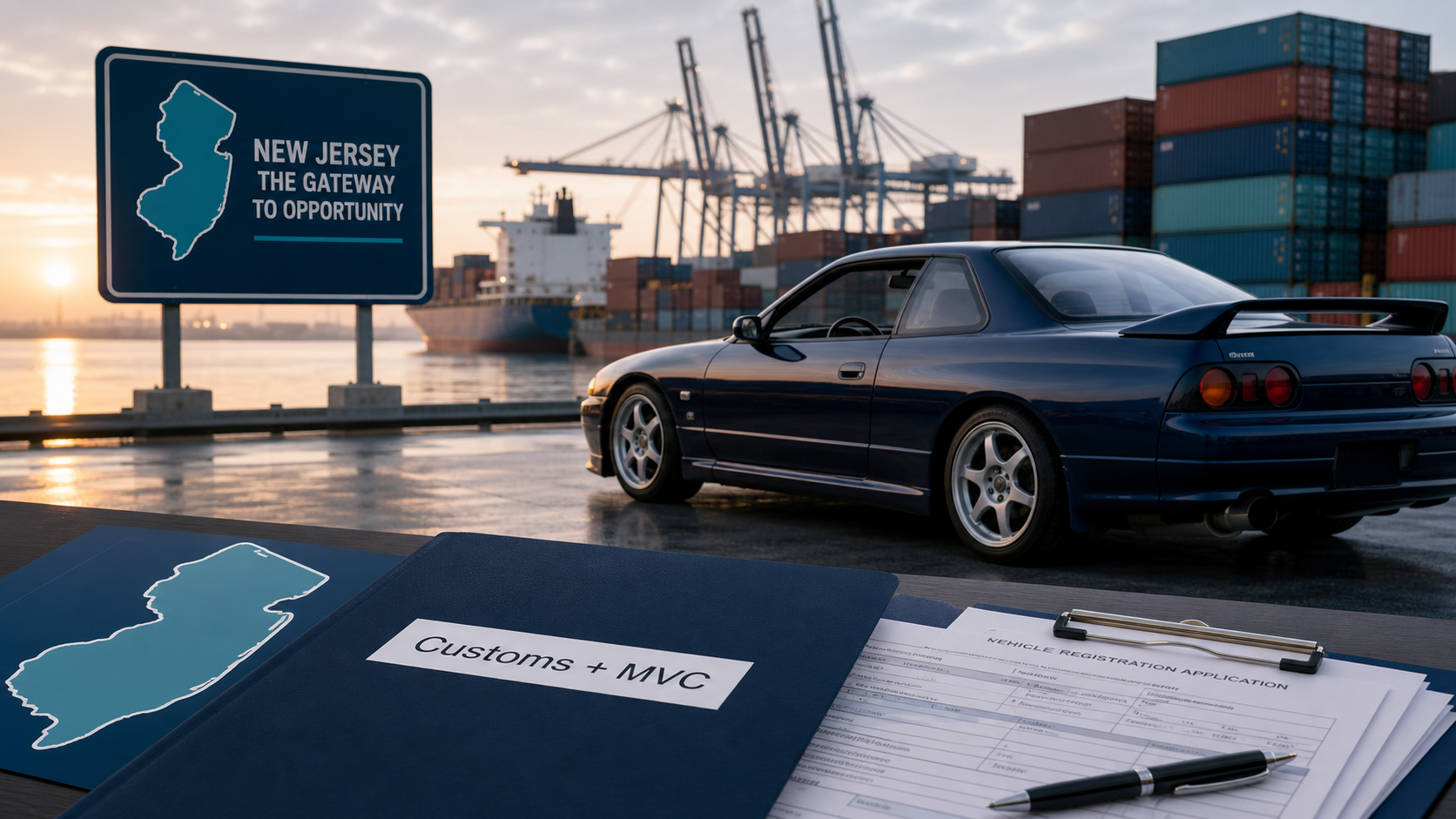
New Jersey matters for JDM imports because it sits right in the Northeast vehicle corridor. Buyers in North Jersey, Central Jersey, South Jersey, Philadelphia suburbs, New York metro, and the port-adjacent market all run into the same basic issue: Customs clearance gets the car into the United States, but New Jersey MVC decides whether the vehicle gets a New Jersey title, registration, plates, and inspection path.
New Jersey can work for federally legal 25-year-old JDM imports, but it has one major wrinkle: foreign vehicle title requests do not start at a normal local MVC counter.
MVC says foreign vehicles must be titled through the central MVC office before they can be registered. That makes the Customs-to-MVC handoff more important than usual. If the import packet is thin, mismatched, untranslated, or missing official Customs documents, the delay may not be a quick counter correction.
Federal import clearance is not New Jersey registration approval
The federal 25-year rule is the import gate. CBP says importers need documents such as the bill of lading, bill of sale, foreign registration, EPA Form 3520-1, and DOT Form HS-7 when importing a motor vehicle. NHTSA also explains that a nonconforming vehicle less than 25 years old generally cannot be imported permanently unless it goes through the Registered Importer path.
New Jersey title and registration are separate state steps.
For JDM buyers, that means a Skyline, Land Cruiser, Pajero, Delica, Silvia, Chaser, Crown, or other Japanese-market vehicle may be federally eligible because it is 25 years old, but MVC still needs a title packet it can process. The vehicle identity, ownership chain, Customs release, EPA/DOT forms, insurance, tax, and inspection status still matter.
Federal eligibility opens the door. It does not hand you New Jersey plates. Logistics, as usual, refuses to be a one-door warehouse.
New Jersey uses a central title process for foreign vehicles
New Jersey MVC says a foreign vehicle must be titled in New Jersey before it can be registered. MVC also says requests to obtain title on a foreign vehicle must be submitted to the central MVC office; local MVC agencies cannot issue this type of transfer.
MVC lists the mailing address as:
- Motor Vehicle Commission
- Special Title Unit
- 225 East State Street 2 East
- Trenton, NJ 08666
MVC also tells applicants to call 609-341-5718 to confirm required paperwork.
That phone call is not busywork. For JDM imports, it is where buyers should confirm the latest foreign-title packet expectations before mailing original documents or planning a registration appointment.
Once the vehicle has a New Jersey title, MVC says the owner may visit an MVC agency to register the vehicle.
Practical New Jersey title packet for a 25-year-old JDM import
New Jersey’s foreign vehicle page is short, so the safe practical approach is to build a complete packet before it reaches the Special Title Unit.
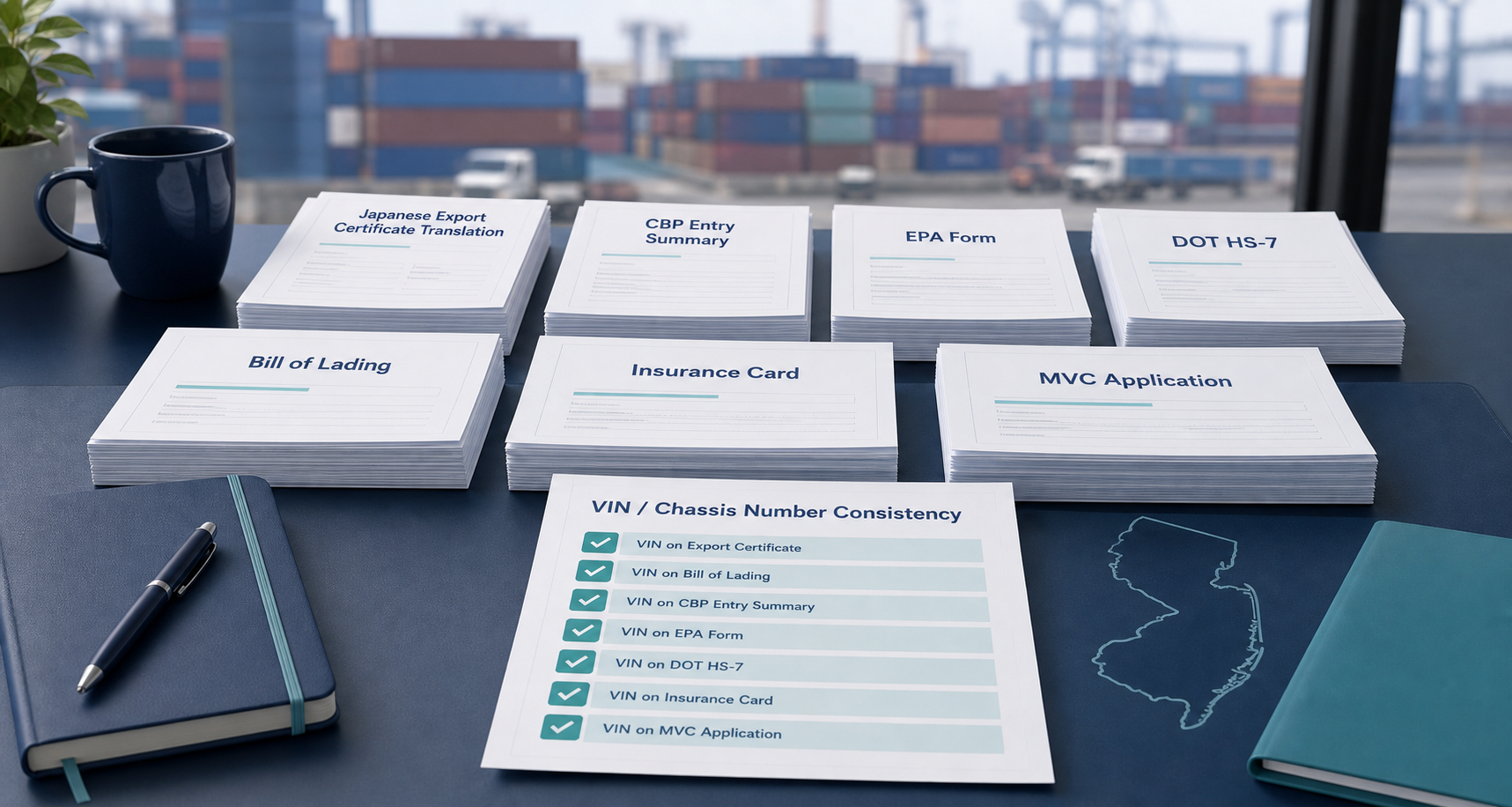
For a federally legal 25-year-old JDM import, the file should usually include:
- Japanese export certificate or other acceptable foreign ownership document
- Certified English translation for Japanese documents
- Purchase invoice or bill of sale
- Bill of lading
- CBP Form 7501 Entry Summary, when used for the entry
- Any other official CBP release or entry document applicable to the shipment
- EPA Form 3520-1
- DOT Form HS-7
- Proof the vehicle is at least 25 years old for federal import purposes
- Odometer disclosure paperwork if MVC requires it for the vehicle and transaction
- Pencil tracing or clear photo of the VIN/chassis number if requested
- New Jersey title application forms required by MVC
- Registration application if applying for registration after title issuance
- New Jersey insurance for registration
- Payment for title, registration, plates, sales tax, and other fees
The exact forms and original-document requirements can vary by transaction, owner type, and MVC handling. Confirm the current packet with MVC before mailing documents.
Do not send the only copy of a Customs document without keeping a clean scan. That is how a $12 scan job turns into a week of phone calls.
Certified English translations should be ready before MVC review
JDM import files often rely on the Japanese export certificate as the main ownership document. New Jersey MVC needs to understand what the document says and how it connects to the vehicle.
If the ownership document is in Japanese, prepare a certified English translation before the title packet goes to MVC.
The translation should preserve the vehicle identity clearly:
- Make
- Model
- Model year or manufacture date information shown on the Japanese document
- Chassis number
- Prior owner or exporter information
- Export or deregistration details
A weak translation can create title friction even when the import is legal. If the translation drops the chassis number, changes the model code, or fails to match the bill of sale and CBP entry, MVC may not treat the packet as a clean chain for one vehicle.
Chassis number consistency is a New Jersey delay point
Many older JDM vehicles do not have a U.S.-style 17-digit VIN. They often use a shorter Japanese chassis number.
That is normal for the vehicle. It is not normal for the documents to identify the car five different ways.
Before the vehicle ships, compare the chassis number across:
- Japanese export certificate
- Certified English translation
- Purchase invoice or bill of sale
- Auction sheet, if available
- Bill of lading
- CBP entry documents
- EPA Form 3520-1
- DOT Form HS-7
- Insurance documents
- New Jersey MVC title forms
- Any VIN tracing or photo submitted with the packet
Be consistent with prefixes, hyphens, spaces, and zeros. If one document says BNR32-012345, another says BNR32012345, and another says only 012345, the vehicle may still be the same car, but MVC should not have to solve that puzzle cold.
New Jersey inspection and emissions rules are age-sensitive
New Jersey’s inspection rules are not the same as every other state in this series.
MVC says certain vehicles are exempt from inspection, including gasoline-powered passenger vehicles that are model year 1995 and older with a GVWR of 8,500 pounds or less. MVC also lists historic motor vehicles, approved collector vehicles, motorcycles, 100% electric vehicles, and several other categories as exempt.
That creates an important timing issue for federally legal 25-year-old JDM imports.
A 1995 gasoline passenger vehicle may fit New Jersey’s 1995-and-older inspection exemption if it also meets the GVWR and registration-category limits. A 2001 vehicle that is federally legal under the 25-year rule in 2026 is not automatically exempt under the 1995-and-older gasoline passenger rule.
Do not assume “25 years old” means “no New Jersey inspection.” New Jersey’s federal import age rule and MVC inspection exemption categories are different systems.
For newer 25-year-rule vehicles, the inspection path may depend on model year, fuel type, weight, registration class, plate type, and whether a historic or collector status applies.
Historic plates can help, but they restrict use
New Jersey offers historic registration for vehicles at least 25 years old.
MVC says a historic vehicle must be at least 25 years old and used only for exhibition and educational purposes by the owner. Historic plates cost $44. MVC also says historic vehicles must not be modified from original manufacturer specification and must be specially registered with QQ plates to qualify as historic for inspection exemption purposes.
For a JDM buyer, historic plates may be a good fit if the vehicle is truly a collector car used for shows, events, educational display, and occasional limited use.
They are not the clean answer for a daily driver.
If the buyer wants to commute in a Skyline, use a Land Cruiser regularly, or drive a Delica as family transportation, standard registration may be the more honest path. The plate decision needs to match the real use, not just the easiest paperwork theory.
Collector vehicle status is usually not the JDM 25-year path
New Jersey also has collector vehicle status, but it is easy to misunderstand.
MVC says collector vehicles must be limited production or made in limited quantities, be less than 25 years old, not be registered as historic or street rod, not be driven more than 3,000 miles per year, and be insured as a limited-use collector vehicle.
That “less than 25 years old” point matters. A federally legal 25-year-old JDM import usually belongs in the normal title/registration or historic-registration conversation, not the collector vehicle status path.
If someone suggests “collector” as the answer, confirm the current MVC requirements before relying on it. The terms sound similar. The rules are not.
Sales tax, title fees, and registration fees still apply
New Jersey MVC lists title fees, registration fees, and sales tax fee requirements for vehicle registration. MVC says sales tax payment is due, and applicants needing help calculating tax can contact the New Jersey Division of Taxation.
For JDM imports, value support matters because the purchase price may be shown on foreign auction paperwork, a Japanese invoice, or broker documents.
Bring or preserve:
- Purchase invoice
- Bill of sale
- Auction invoice or auction sheet if available
- Payment records if needed
- Certified translation if price or vehicle details are not in English
- Customs entry documents showing declared value
- Freight or landed-cost documents if requested
Sales tax is a state issue, not a Customs-duty issue. Paying duty at import does not automatically settle New Jersey tax or registration fees.
Common New Jersey JDM registration delays
The most common delay points are practical:
- Buyer tries to title a foreign vehicle at a local MVC agency instead of using the central process
- MVC title packet is mailed without confirming current requirements
- Japanese export certificate is missing or not translated
- Translation is not certified or does not match the vehicle identity
- Chassis number format changes across documents
- Buyer has a broker worksheet but not official CBP entry/release paperwork
- EPA Form 3520-1 or DOT Form HS-7 is missing
- Bill of lading or bill of sale does not match the chassis number
- Vehicle age is assumed instead of documented
- Buyer assumes a 25-year federal import automatically avoids New Jersey inspection
- Historic plates are requested even though the owner plans regular transportation
- Collector vehicle status is confused with historic registration
- Tax/value support is incomplete
- Original documents are mailed without clean scans retained
Most of these are preventable before the vehicle arrives. After arrival, they become the kind of paperwork scavenger hunt nobody enjoys.
Should New Jersey buyers import JDM vehicles?
Often, yes, but New Jersey is a process-sensitive state.
A New Jersey JDM import may make sense if:
- The vehicle is federally legal under the 25-year rule
- The buyer has a clean Japanese ownership or export document
- Certified English translations are ready
- CBP entry documents are saved and match the vehicle
- EPA 3520-1 and DOT HS-7 are in the file
- The chassis number is consistent everywhere
- The buyer confirms the central MVC title packet before mailing documents
- New Jersey insurance is ready for registration
- The inspection or exemption path is understood before purchase
- The buyer chooses standard or historic plates based on actual use
- Tax and value support are ready
It may not make sense if the seller cannot prove ownership, the chassis number trail is messy, the buyer wants daily use on historic plates, the vehicle needs an inspection path that has not been confirmed, or the import file is missing official Customs documents.
Bottom line
New Jersey can be workable for 25-year-old JDM imports, but buyers need to respect the handoff from federal import clearance to MVC title, registration, inspection, tax, and plate rules.
The biggest New Jersey-specific point is simple: foreign vehicle title requests go through the central MVC office before registration. Build the file carefully, confirm current requirements with MVC, keep the chassis number consistent, prepare translations, save the official CBP paperwork, and do not assume federal 25-year eligibility answers state inspection or plate questions.
AWIS can help with the Customs side of a JDM import, including entry planning, CBP paperwork coordination, duty, EPA/DOT documentation, and release planning. For New Jersey title, registration, inspection, insurance, tax, and plate decisions, confirm requirements directly with New Jersey MVC before purchase or arrival.
This article is general information, not legal advice. New Jersey requirements can change, MVC handling can vary, and title, tax, insurance, inspection, emissions, and plate rules can depend on model year, fuel type, vehicle classification, owner facts, documents, and intended use. Confirm requirements directly before purchase.
Sources reviewed
- New Jersey MVC, Foreign Vehicles
- New Jersey MVC, Vehicle Registration
- New Jersey MVC, Historic and Street Rod
- New Jersey MVC, Vehicles Exempt From Inspection
- New Jersey MVC, Collector Vehicles
- New Jersey MVC, Vehicles Exempt From Sales Tax
- U.S. Customs and Border Protection, Importing a Motor Vehicle
- NHTSA, Importation and Certification FAQs
- U.S. EPA, Publications and Forms for Importing Vehicles and Engines