Florida is often a practical destination for 25-year-old JDM imports. It has active ports, a large enthusiast market, and no California-style direct-import emissions maze for most older passenger vehicles.
But Florida being “easier” does not mean registration is automatic. Customs release is only the federal side of the process. Florida still has its own title, VIN verification, tax, insurance, and county tax collector requirements before the vehicle can be titled and registered.
The real question for a Florida-bound JDM buyer is not simply, “Do I have import documents?” It is: will the Florida office reviewing the vehicle have everything it needs to issue a title and plate without sending me away?
Quick answer: Florida is friendly, but paperwork and tax still matter
For many older Japanese imports, Florida is friendlier than states that require emissions testing or special safety inspections. Still, the common hurdles are:
- VIN / chassis number verification, especially because many JDM vehicles do not have a 17-digit U.S.-style VIN.
- Foreign ownership documents and translations, usually including the Japanese export certificate and a certified English translation.
- Customs and federal import paperwork, including CBP, DOT, and EPA documents where applicable.
- Florida insurance when the buyer wants to register and plate the vehicle.
- Florida sales or use tax, which may be due when the vehicle is titled or registered.
- County-level interpretation, because Florida title work is commonly handled through county tax collector offices.
Florida JDM registration hurdles checklist
| Requirement | Florida rule / practical issue | Why it matters for JDM imports |
|---|---|---|
| Emissions test | Florida does not currently require emissions testing for vehicle registration. | This removes one major barrier found in stricter states, but it does not replace federal EPA import compliance. |
| Safety inspection | Florida does not have a broad annual passenger-vehicle safety inspection program. | The car still needs to be legally and safely operable, but Florida usually will not require a separate state safety inspection just to register it. |
| VIN / chassis verification | Out-of-country vehicles generally need VIN and odometer verification, commonly using Florida form HSMV 82042. | Short Japanese chassis numbers can confuse clerks or verifiers if the number does not match every document exactly. |
| Foreign ownership documents | Florida may require the out-of-country title / ownership document and a certified English translation. | Japanese export certificates should be prepared before the DMV visit, not after a rejected appointment. |
| Sales / use tax | Florida sales or use tax may be due on motor vehicles imported into Florida, plus applicable discretionary county surtax. | Buyers should be ready to document the purchase price, declared value, and any tax already paid or credited. |
| Antique / historical registration | Florida has antique / historical plate options for qualifying older vehicles, commonly 30 years and older. | This may be useful for some JDM imports, but it is not the same as avoiding title requirements, tax, or proper import paperwork. |
| County tax collector review | The transaction is often handled locally, and offices may interpret unusual import paperwork differently. | Calling ahead can prevent wasted appointments and document surprises. |
No Florida emissions test for registration
Florida does not currently require an emissions or smog test to register a vehicle. That is a major advantage compared with states where imported vehicles can get stuck because of state emissions rules, testing equipment, or direct-import requirements.
For a 25-year-old JDM vehicle, this usually means the Florida registration conversation is more about title documents, VIN verification, insurance, and taxes than about a state emissions inspection.
Important distinction: Florida not requiring a state emissions test does not erase federal import requirements. The vehicle still needs to have been imported correctly under the applicable federal rules, including the 25-year NHTSA exemption and any EPA paperwork or exemption that applies to the vehicle.
No general Florida safety inspection, but the car still needs to be roadworthy
Florida also does not have the kind of annual safety inspection program that exists in some other states. For many JDM buyers, that simplifies registration compared with states that require inspection stations to verify lights, brakes, glass, mirrors, equipment, or emissions items before a plate is issued.
That does not mean equipment condition should be ignored. A Florida buyer should still check practical road-use items before driving the car:
- Headlights, brake lights, turn signals, hazard lights, and reverse lights
- Brake condition and tire condition
- Windshield, wipers, mirrors, and horn
- Seat belts and basic safety equipment
- Insurance eligibility for a right-hand-drive imported vehicle
Florida may not ask for a state safety inspection, but insurers, lenders, law enforcement, or a future buyer may still care whether the vehicle is safe and properly documented.
VIN and odometer verification is one of the biggest Florida hurdles
For an imported vehicle coming from outside the United States, Florida commonly requires motor vehicle identification number and odometer verification. The form many buyers encounter is HSMV 82042 — Vehicle Identification Number and Odometer Verification.
This can be completed by authorized parties listed on the form, such as a Florida notary, licensed Florida dealer, law enforcement officer, or other authorized verifier.
The JDM-specific issue is that many Japanese vehicles use a chassis number instead of a 17-digit U.S. VIN. That shorter number must be handled consistently. The number on the car should match the number on:
- Japanese export certificate or foreign ownership document
- Certified English translation
- Bill of sale or purchase invoice
- Bill of lading / arrival documentation
- CBP Form 7501 entry summary
- DOT HS-7
- EPA Form 3520-1, when included
- Florida VIN / odometer verification form
A single extra dash, missing prefix, typo, or mismatch between documents can delay the title process.
Florida title offices may scrutinize Japanese documents and translations
Florida title review is document-driven. Buyers should not assume a county office will understand a Japanese export certificate, auction paperwork, or chassis number format without a clean packet.
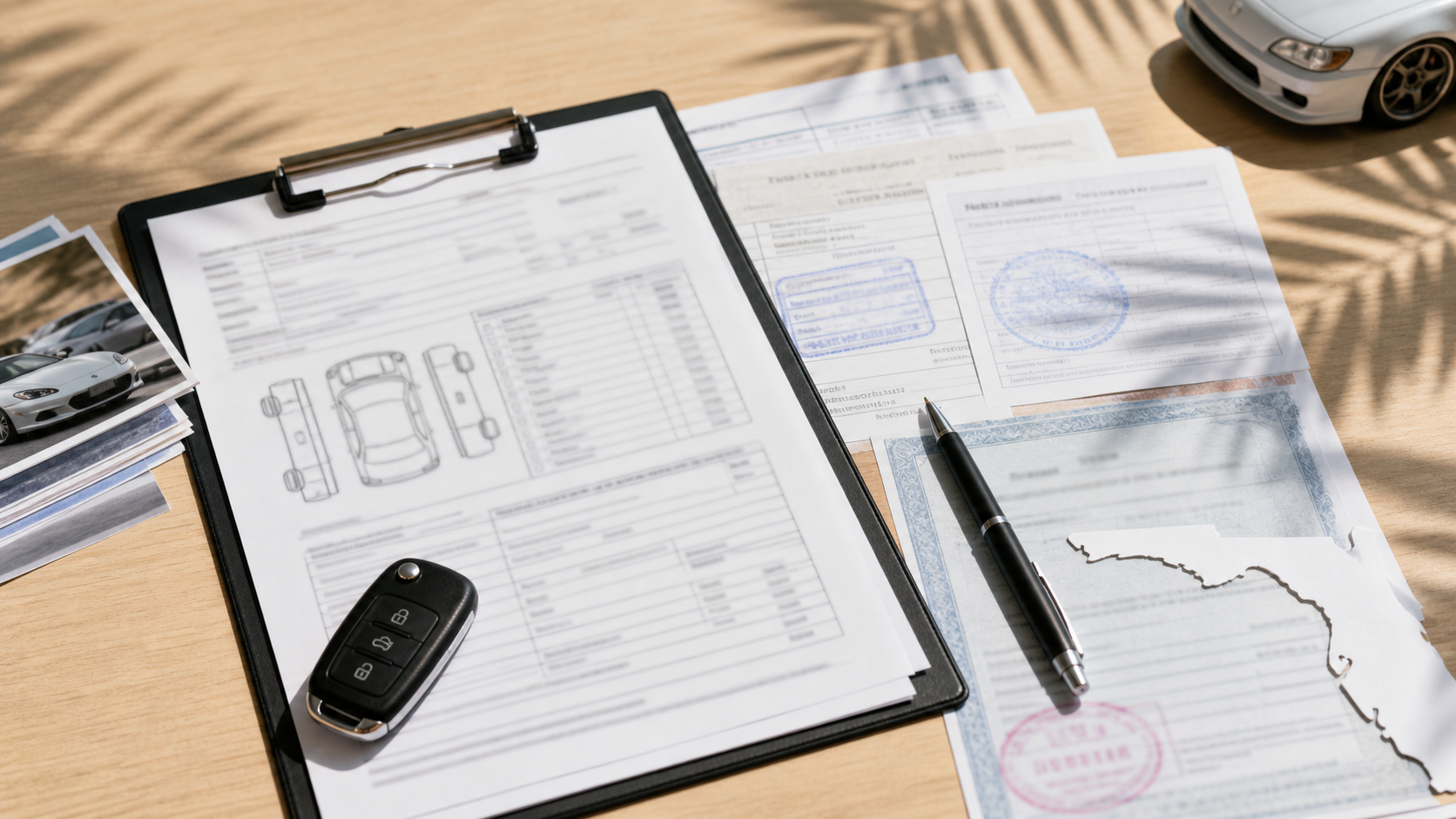
For a Florida-bound JDM vehicle, prepare:
- Japanese export certificate or other foreign ownership document
- Certified English translation if the ownership document is not in English
- Purchase invoice or bill of sale
- Bill of lading or arrival notice
- CBP Form 7501 entry summary
- DOT Form HS-7
- EPA Form 3520-1, if part of the import file
- VIN and odometer verification, commonly HSMV 82042
- Valid ID for the owner
- Power of attorney if someone else handles the title work
- Proof of Florida insurance when registration is requested
- Sales tax / use tax documentation
The safest approach is to review the Florida title packet before the vehicle arrives, not after the buyer has already paid for storage, inland transport, or a failed tax collector appointment.
Florida sales tax and use tax: will the buyer have to pay?
Often, yes. Florida generally imposes sales or use tax on motor vehicles sold, delivered into, imported into, titled, registered, or used in Florida. Florida’s general state sales tax rate is 6%, and applicable discretionary county surtax may also apply.
For imported vehicles, the county tax collector may look at the declared value, purchase price, bill of sale, foreign invoice, and whether any legally creditable tax was already paid. If the vehicle was purchased while out of the country and is being titled in Florida, buyers should be prepared for Florida tax to be due at the time of title application.
Common tax issues for JDM importers include:
- The bill of sale or invoice does not clearly show the vehicle price.
- The buyer assumes Customs duty is the same thing as Florida sales tax. It is not.
- The buyer paid foreign fees or auction costs and is unsure what value Florida will use.
- The buyer does not bring tax documentation to the county office.
- The county asks for additional proof of purchase price or declared value.
Customs duty, brokerage charges, ocean freight, and port fees are separate from Florida sales / use tax. A buyer should budget for the tax conversation instead of treating registration fees as the only cost due at the counter.
Antique or historical plates may help some JDM vehicles, but they are not a shortcut
Florida offers antique / historical plate options for qualifying older vehicles, commonly 30 years and older. Since many JDM imports are entering the United States under the 25-year rule, not every newly eligible import will be old enough for Florida antique treatment immediately.
That creates an important distinction:
- A 25-year-old vehicle may be federally eligible for import.
- That same vehicle may not yet qualify for Florida antique / historical plates if the Florida age threshold is higher.
For a vehicle that does qualify, antique or historical registration may be a good option, but it does not eliminate the need for proper title documents, VIN verification, taxes, insurance where applicable, or federal import records. Buyers should also confirm whether the plate type has use expectations or limitations before choosing it.
County offices can vary, so call before the car arrives
Florida title and registration work is commonly handled through county tax collector offices. Some offices are more familiar with out-of-country title transfers than others.
Before the vehicle arrives, ask the county office or tag agency:
- Do you process out-of-country vehicle title transactions?
- Which documents do you require for a Japanese import?
- Do you require a certified translation of the export certificate?
- Who may complete the VIN / odometer verification?
- What proof of sales price or declared value do you need for tax?
- Will you title the vehicle with a non-17-digit chassis number?
- Are there county-specific forms or appointment requirements?
This is especially important for right-hand-drive imports, kei vehicles, unusual body types, or vehicles with chassis numbers that do not look like standard U.S. VINs.
Common Florida mistakes JDM buyers should avoid
- Assuming Customs release means Florida title approval.
- Arriving without a certified English translation.
- Using inconsistent VIN / chassis formatting across documents.
- Confusing federal EPA / DOT paperwork with Florida registration requirements.
- Forgetting Florida insurance before requesting registration.
- Assuming no emissions test means no tax, no verification, or no title review.
- Waiting until the vehicle is delivered to ask the county office what it requires.
- Assuming a 25-year-old import automatically qualifies for Florida antique plates.
How AWIS helps Florida JDM importers
AWIS focuses on the Customs and import documentation side of the move. That matters because the Florida title packet often depends on clean federal import records, consistent VIN / chassis information, and properly prepared supporting documents.
A customs broker cannot promise that a county tax collector will approve a title application. But a clean import file gives the buyer a stronger starting point when Florida asks for Customs entry, DOT, EPA, proof of ownership, and value documentation.
For JDM buyers, the goal is to avoid the common gap between “the car cleared Customs” and “the car can actually be titled and registered.”
Bottom line for Florida JDM buyers
Florida is generally friendlier than stricter emissions states, but it is not a paperwork-free state. Expect VIN verification, foreign document review, possible certified translations, insurance, and sales / use tax questions.
Before the vehicle arrives, make sure the import packet and Florida title packet tell the same story: same buyer, same vehicle, same chassis number, same declared value, and the right supporting forms.
Importing a JDM vehicle into Florida? AWIS can help review the customs side of the file so the documentation is organized before you walk into the title office.
Sources and important note
- Florida Highway Safety and Motor Vehicles forms and title procedures, including HSMV 82042 VIN / odometer verification.
- Florida Department of Revenue guidance on sales and use tax for motor vehicles.
- County tax collector guidance for out-of-country title transfers.
This article is general planning information, not legal or tax advice. Florida requirements can change, and county offices may request additional documents. Confirm requirements with the Florida county tax collector or tag agency before the vehicle arrives.