Welcome to the next article in AWIS’ JDM state registration series.
Oregon matters for JDM imports because Portland, Salem, Eugene, Bend, Medford, and the Pacific Northwest enthusiast market all see steady demand for right-hand-drive Japanese vehicles. It is also a state where buyers need to separate three things: federal import clearance, Oregon title approval, and Oregon registration/plate use.
For an Oregon buyer, the practical handoff usually comes down to the Customs packet, original Japanese ownership documents, certified translations where needed, Oregon Application for Title and Registration Form 735-226, VIN inspection, proof of federal standards/compliance or import release, DEQ planning if the vehicle will be registered in a testing area, insurance, fees, and the plate choice.
The main Oregon-specific point: DMV says out-of-country titled vehicles need a VIN inspection, and Oregon DEQ says it will not perform the VIN inspection for an out-of-country vehicle. That can catch buyers who assume the emissions station can handle everything in one stop.
Federal import clearance is not Oregon registration approval
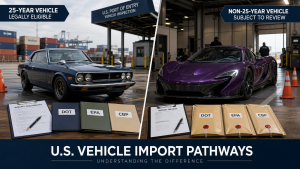
The federal 25-year rule is the import gate. NHTSA allows a motor vehicle that is at least 25 years old to be imported without regard to whether it complies with all applicable Federal Motor Vehicle Safety Standards, using the 25-year basis on DOT Form HS-7. EPA rules separately allow many vehicles at least 21 years old in original configuration to use an EPA import exemption on Form 3520-1. CBP guidance still tells importers to keep the bill of lading, bill of sale, foreign registration, EPA Form 3520-1, DOT Form HS-7, and entry paperwork.
Oregon title and registration are separate state steps.
A Skyline, Land Cruiser, HiAce, Delica, Chaser, Crown, Silvia, Pajero, kei truck, kei van, or other Japanese-market vehicle may clear CBP as a federally legal import and still hit Oregon delays if the state title packet does not explain the vehicle clearly.
Customs release gets the car into the country. Oregon paperwork gets it titled, registered, and plated. Different gate. Same ability to ruin a buyer’s week with one missing document.
Oregon starts with title before registration
Oregon DMV says a vehicle must be titled in Oregon if the owner wants to register it. To title a vehicle, the buyer generally submits a completed title application, the original title or ownership document, any lien releases or bills of sale needed to show ownership, odometer disclosure if required, VIN inspection when the vehicle has an out-of-state or foreign title, title fees, and any registration and plate fees.
For passenger vehicles, Oregon uses the Application for Title and Registration, Form 735-226, or the guided DMV2U title application path where available. A JDM import is not always a clean online transaction, so buyers should be ready for an in-person or mail packet with supporting documents.
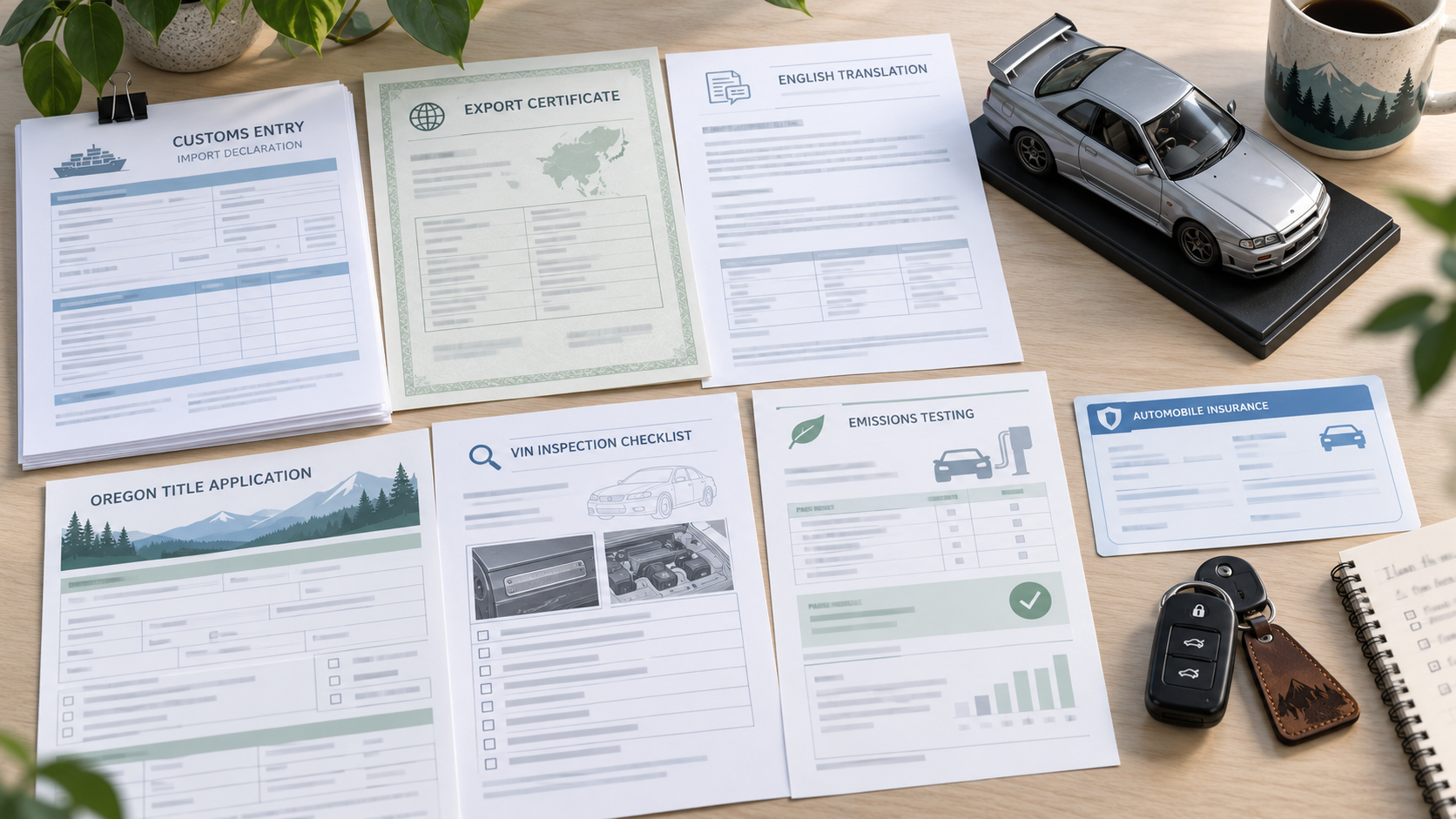
For a first Oregon title after import, the practical file usually includes:
- Completed Oregon Application for Title and Registration, Form 735-226
- Original Japanese export certificate, deregistration document, or other foreign ownership document
- Certified English translation for Japanese documents where Oregon requires translation
- Bill of sale and invoice chain from seller/exporter to Oregon applicant
- Bill of lading and arrival documents
- CBP Form 7501 Entry Summary
- DOT Form HS-7 showing the 25-year import basis, or other federal safety exemption support
- EPA Form 3520-1 showing the applicable emissions exemption, or other EPA support
- Any CBP release or duty/payment backup available
- Oregon VIN inspection
- Odometer/kilometer disclosure handling where applicable
- Oregon insurance for registration
- DEQ certificate if the vehicle requires emissions testing in the registration area
- Fee payment for title, registration, plates, and any plate-specific charges
The exact packet can vary by model year, fuel type, vehicle class, owner facts, documents, use, and how Oregon DMV handles the file.
Foreign ownership documents and translations matter
Oregon DMV asks for the original title or ownership document. For a JDM vehicle, that usually means the Japanese export certificate, deregistration certificate, or another foreign ownership document that actually proves the vehicle’s ownership history.
Do not treat an auction sheet as the title. Auction sheets are useful backup, but they are not the same as the foreign ownership document Oregon needs to issue a state title.
Oregon’s title guidance also says documents written in a language that uses a different alphabet than English need a certified translation. For Japanese documents, that translation should be ready before the buyer walks into DMV.
A clean translation should preserve the key vehicle facts:
- Year or first registration date
- Make and model
- Body type where shown
- Chassis number or VIN
- Engine displacement where shown
- Owner/exporter details where shown
- Odometer or kilometer information where shown
Many JDM vehicles do not have a 17-digit U.S.-style VIN. They use chassis numbers such as BNR32-012345, JZX100-0000000, KZH106-0000000, JA11-123456, or something similar. Oregon can process out-of-country vehicles, but the identity trail needs to be clear.
Before submitting the packet, compare the chassis number across the export certificate, translation, bill of sale, exporter invoice, bill of lading, CBP Form 7501, DOT HS-7, EPA 3520-1, Oregon title application, insurance documents, and the chassis plate on the vehicle.
Hyphens, zeros, prefixes, and model codes matter. The state clerk should not have to become a Nissan archaeologist to figure out whether two documents describe the same car.
Oregon asks for proof tied to federal standards or import status
Oregon DMV’s title and registration page says an imported vehicle, or a vehicle not made by one of DMV’s recognized major manufacturers, may need proof of compliance with U.S. standards. Oregon lists several possible types of proof, including DMV viewing federal safety and EPA labels, a dealer certification by an Oregon dealer, CBP Form CF7501 or CBP7501, a manufacturer letter stating the vehicle meets federal safety and emissions standards, or written military import paperwork for military imports.
For a 25-year-old JDM import, the most practical state file usually leans on the official import documents, especially CBP Form 7501, DOT HS-7, and EPA 3520-1.
CBP Form 7501 matters because it shows the vehicle entered through Customs. DOT HS-7 explains the federal safety import basis. EPA 3520-1 explains the federal emissions import basis. Together with the foreign ownership document and translation, they tell Oregon what the vehicle is and why it was lawfully admitted.
A broker invoice is helpful. A shipping invoice is useful. Neither replaces official entry paperwork.
Oregon VIN inspection is required for out-of-country titles
Oregon DMV says a VIN inspection is required for out-of-state or out-of-country titled vehicles. DMV describes the VIN inspection as a physical examination to verify that the VIN on the vehicle matches the title or ownership document. The fee listed by DMV is $9.
For JDM imports, this is really a chassis-number inspection. The vehicle may not have a U.S.-style 17-digit VIN, so the buyer should make the number easy to find and easy to match.
Before the inspection, confirm:
- Where the chassis number appears on the vehicle
- Whether the chassis plate is readable and attached
- Whether the stamped number matches the Japanese ownership document
- Whether the translation preserved the same number format
- Whether the CBP 7501, HS-7, EPA 3520-1, and insurance use the same format
- Whether the Oregon application uses the same number format
Oregon DMV says VIN inspections can be done by DMV, by a licensed Oregon vehicle dealer when buying from that dealer, or by Oregon DEQ only if the vehicle must be emissions tested. But Oregon DEQ separately says it will not conduct a VIN inspection if the vehicle is from out-of-country.
That is the Oregon trapdoor. If the vehicle is a direct Japanese import, plan on DMV handling the VIN inspection unless DMV tells the buyer otherwise.
DEQ emissions testing depends on where the vehicle is registered
Oregon emissions testing is not statewide. Oregon DEQ says most vehicles in the Portland and Medford metro areas need emissions testing before registration if they fall within the program rules.
For Portland-area registration, DEQ lists all 1975 and newer gasoline, alternative fuel, hybrid vehicles, and light-duty diesel vehicles at 8,500 pounds GVWR or less registered within Portland testing boundaries.
For Medford-area registration, DEQ lists gasoline, alternative fuel, hybrid vehicles, and light-duty diesels that are 20 years old or less and registered within the Medford testing boundaries.
That creates very different outcomes for a 25-year-old JDM vehicle depending on location. A 2001 federally eligible JDM import registered in 2026 may be old enough to be outside Medford’s 20-year window, but Portland’s program reaches back to 1975 for gasoline and similar vehicles inside the testing boundary.
The practical questions are:
- Will the vehicle be registered inside Portland or Medford DEQ boundaries?
- Is it gasoline, diesel, hybrid, electric, or another fuel type?
- Is it 1975 or newer?
- Is it 20 years old or less for the Medford program?
- Is it light-duty diesel at 8,500 pounds GVWR or less?
- Does it have OBD equipment that Oregon can test if the model year requires that approach?
- Is the vehicle eligible for a plate path that changes the registration/use analysis?
Right-hand drive is not the emissions problem. A non-U.S.-market OBD or emissions configuration in the Portland testing area can be.
Special interest plates are not daily-driver plates
Oregon offers regular registration and special plate paths. For JDM buyers, the important older-vehicle path is often Oregon’s special interest vehicle category.
Oregon’s special interest certification form says a special interest vehicle can be a vehicle with a model year at least 25 years old. Oregon law also describes a vehicle of special interest as an American or foreign-made vehicle maintained as a collector’s item. The special interest plate statute requires the owner to maintain the vehicle as a collector item and use it only for exhibitions, parades, club activities, and similar uses, not primarily for transportation of persons or property.
That is useful, but it is not a regular-use loophole.
A 25-year-old JDM import may fit Oregon special interest eligibility if it is truly being kept and used as a collector vehicle. It may not fit if the buyer wants a daily commuter, regular work vehicle, or year-round normal-use car.
Oregon antique vehicle status is a different concept. Oregon defines antique vehicle in a way that is much older than the federal 25-year import rule: older than one-half the number of years between the current year and 1900 and maintained as a collector’s item. In 2026, that means many 25-year-old JDM imports are special-interest age, not antique age.
Pick the plate path based on the actual use. Plate paperwork is not a creative writing exercise, even though DMV forms sometimes make it feel like one.
Insurance still needs to handle a Japanese chassis number
Oregon registration generally requires the vehicle to be properly titled and registered, and drivers need to comply with Oregon financial responsibility requirements. For a JDM import, the practical issue is often whether the insurance carrier can bind coverage using the Japanese chassis number.
Before the Oregon application goes in, confirm:
- The insurer can cover the specific imported vehicle
- The policy can use a non-17-digit chassis number if there is no U.S.-style VIN
- The year, make, model, body type, and chassis number match the title file
- The policy fits the intended use, especially if using collector or special interest registration
- The insurance card does not change the chassis format in a way that conflicts with DMV paperwork
Insurance formatting mistakes are boring. They are also exactly the kind of boring thing that delays a title file.
Odometer and kilometer readings should be handled cleanly
Many JDM imports have odometers in kilometers. Oregon title work can involve odometer disclosure depending on model year and transaction facts.
For a 25-year-old imported vehicle, the buyer should keep the original reading clear. Do not casually convert kilometers to miles in one document and leave kilometers in another without explaining what happened.
A clean file should show:
- Original odometer reading as displayed
- Whether the reading is kilometers or miles
- Any conversion used for buyer records
- Whether the vehicle is exempt from odometer disclosure because of age under current rules
- Whether the foreign ownership document or translation lists a distance reading
If the bill of sale says miles, the export certificate says kilometers, and the title application says something else, the delay is predictable.
Taxes and fees are separate from Customs duty
Customs duty at the port is not Oregon title and registration cost. Oregon title, registration, plate, VIN inspection, and any special plate fees are separate.
Oregon DMV says title applications must include the title fee and any registration and plate fees. DMV also notes that some brand-new or very low-mileage vehicles bought from an out-of-state dealer may need a use tax certificate. For most 25-year-old JDM imports, the buyer should still check the current Oregon DMV and Department of Revenue handling before assuming no tax or fee applies.
Useful value records include:
- Purchase invoice
- Bill of sale
- Auction invoice or auction sheet, if available
- Exporter invoice
- Payment proof, if available
- CBP entry value
- Freight and landed-cost support
- English translation for value documents written only in Japanese
The Customs file and Oregon title file overlap, but they are not the same bill.
Kei trucks, vans, and cars in Oregon
Oregon does not have one simple JDM kei answer that fits every buyer. A kei truck, kei van, or kei car still needs the same basics: federal eligibility, CBP entry proof, original foreign ownership documents, translations, Oregon title application, VIN inspection, insurance, emissions planning where relevant, and a plate path that matches the intended use.
Practical kei-specific points:
- Confirm the vehicle is federally eligible before purchase
- Confirm the Japanese chassis number is consistent across every document
- Confirm the export certificate and bill of sale describe the vehicle clearly
- Do not assume special interest plates allow regular work or daily use
- Check DEQ requirements before buying if the vehicle will be registered in Portland or Medford testing areas
- Confirm insurance before the vehicle lands
- Be careful with off-road-only assumptions; title, registration, and road use are separate questions
Kei vehicles are where internet advice gets expensive. Oregon DMV’s current handling matters more than a forum post from someone who titled a different truck five years ago.
Practical Oregon packet for a 25-year-old JDM import
For a federally legal 25-year-old JDM import going into Oregon, a practical packet should usually include:
- Original Japanese export certificate, deregistration document, or other foreign ownership evidence
- Certified English translation where required
- Bill of sale showing year, make, model, chassis/VIN, purchase price, seller, and buyer
- Purchase invoice and value support
- Bill of lading and arrival documents
- CBP Form 7501 Entry Summary
- Any CBP release or entry backup available
- DOT Form HS-7 showing the 25-year import basis, or other DOT exemption support
- EPA Form 3520-1 showing the applicable exemption, or other EPA exemption support
- Duty/payment support where applicable
- Oregon Application for Title and Registration, Form 735-226
- Oregon VIN inspection
- Oregon insurance that can use the Japanese chassis number where needed
- Odometer/kilometer explanation where applicable
- DEQ emissions certificate if required by the registration location and vehicle type
- Plate decision: standard, special interest, or another eligible Oregon plate path
- Fee payment for title, registration, VIN inspection, plates, and any special plate charges
The exact packet can vary by vehicle age, fuel type, model year, seller, documents, location, DEQ status, plate choice, and how DMV handles the file.
Common Oregon JDM registration delays
The most common Oregon delay points are avoidable:
- Buyer does not have the original Japanese ownership/export document
- Japanese documents are not translated when needed
- CBP Form 7501 is missing
- Buyer has a broker invoice but not official Customs entry proof
- DOT HS-7 or EPA 3520-1 is missing from the practical file
- Chassis number format changes across Customs, ownership, insurance, and DMV forms
- Buyer assumes Oregon DEQ can do the VIN inspection for an out-of-country vehicle
- Vehicle is registered in a DEQ area without checking emissions rules first
- Portland and Medford DEQ rules are treated as the same rule
- Insurance carrier cannot issue coverage using the Japanese chassis number
- Special interest plates are requested for normal daily use
- Odometer kilometers are treated inconsistently across documents
- Buyer assumes federal import approval means automatic Oregon title approval
Most of this can be fixed before the vehicle ships. After arrival, every missing page becomes a storage-fee scavenger hunt.
Should Oregon buyers import JDM vehicles?
Often, yes. Oregon can be workable for 25-year-old JDM imports when the buyer prepares the file correctly and checks DEQ and plate issues early.
An Oregon JDM import may make sense if:
- The vehicle is federally legal under the 25-year rule
- The ownership/export document is original and clean
- Translations are ready where needed
- The bill of sale chain connects the seller/exporter to the Oregon applicant
- CBP Form 7501 and release backup are saved
- DOT HS-7 and EPA 3520-1 are handled and retained
- Oregon Form 735-226 is prepared correctly
- VIN inspection planning is clear
- The chassis number is consistent across every document
- Oregon insurance is confirmed before registration
- DEQ handling is checked before purchase if the vehicle will be registered in Portland or Medford areas
- The plate path matches actual use
It may not make sense if the seller cannot provide ownership documents, the chassis number trail is messy, the buyer cannot get translations, the vehicle is not federally eligible, the insurer cannot write coverage, or the buyer expects special interest plates to cover normal transportation use.
Bottom line
Oregon is not impossible for 25-year-old JDM imports, but it is detail-sensitive.
The Oregon handoff usually comes down to original foreign ownership documents, certified translations where needed, CBP Form 7501, DOT HS-7, EPA 3520-1, Oregon Form 735-226, VIN inspection, insurance, DEQ planning in Portland or Medford areas, and an honest plate decision.
AWIS can help with the Customs side of a JDM import, including entry planning, CBP paperwork coordination, duty, EPA/DOT documentation, and release planning. For Oregon title, registration, insurance, emissions, plate selection, and final road-use questions, confirm current requirements directly with Oregon DMV, Oregon DEQ where relevant, and the buyer’s insurance provider before purchase or arrival.
This article is general information, not legal advice. Oregon requirements can change, office handling can vary, and title, insurance, emissions, VIN inspection, plate, and road-use rules can depend on model year, fuel type, documents, vehicle classification, owner facts, location, and intended use. Confirm requirements directly before purchase.
Sources reviewed
- Oregon DMV, Titling and Registering Your Vehicle
- Oregon DMV, Title and Registration Instructions for Vehicles New to Oregon, Form 6603
- Oregon DMV, Vehicle Identification Number Inspections
- Oregon DMV, License Plates
- Oregon DMV, Antique / Special Interest Vehicle Certification, Form 6577
- Oregon DEQ, Vehicles Tested and Exempted
- Oregon DEQ, DMV Registration and VIN Inspection
- Oregon Revised Statutes, vehicle of special interest and special interest vehicle plate provisions
- U.S. Customs and Border Protection, Importing a Motor Vehicle
- NHTSA, DOT Form HS-7 and 25-year import basis
- EPA, Form 3520-1 vehicle import declaration