
Welcome to the next article in AWIS’ JDM state registration series.
Ohio matters for JDM imports because Columbus, Cleveland, Cincinnati, Dayton, Toledo, and the broader Great Lakes enthusiast market all generate steady demand for right-hand-drive Japanese vehicles. Military PCS traffic through Wright-Patterson Air Force Base in Dayton, the Defense Supply Center Columbus, and the Youngstown Air Reserve Station also drives JDM registration volume. Ohio also has a few quirks that catch first-time importers: titles are issued by County Clerk of Courts title offices rather than the BMV directly, VIN inspection happens at a deputy registrar or participating dealer, and Ohio E-Check emissions testing only applies in seven northeast counties.
For an Ohio buyer, the practical handoff usually comes down to the Customs packet, foreign title or registration, certified English translations, an out-of-state VIN inspection on Form BMV 3787, Form HS-7, EPA Form 3520-1, insurance, taxes and fees, Ohio E-Check planning in the Cleveland-Akron area, and the plate decision.
The main Ohio-specific point: a 2001-era JDM import is actually at the top end of Ohio’s E-Check age window. Ohio E-Check currently applies to gasoline and diesel vehicles 6 to 25 years old in program counties. A vehicle older than that falls outside the regular biennial testing cycle. That changes the practical picture for a federally legal 25-year-old JDM import depending on model year and county of registration.
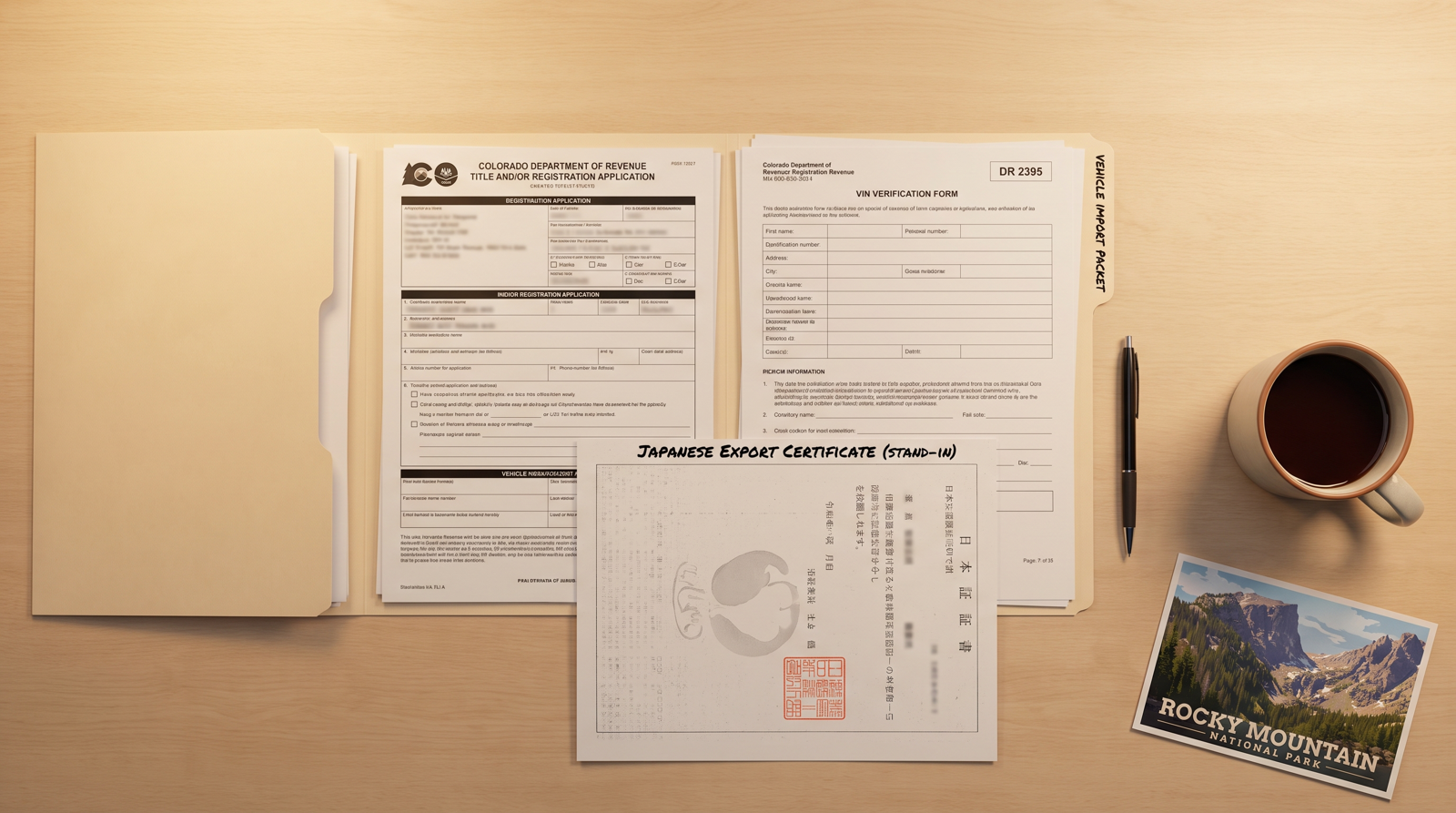
Federal import clearance is not Ohio registration approval
The federal 25-year rule is the import gate. NHTSA allows a motor vehicle that is at least 25 years old to be imported without regard to whether it complies with all applicable Federal Motor Vehicle Safety Standards, using the 25-year basis on DOT Form HS-7. EPA rules separately allow many vehicles at least 21 years old in original configuration to use an EPA import exemption on Form 3520-1. CBP guidance still tells importers to keep the bill of lading, bill of sale, foreign registration, EPA Form 3520-1, DOT Form HS-7, and entry paperwork.
Ohio title and registration are separate state steps.
A Skyline, Land Cruiser, HiAce, Delica, Chaser, Crown, Silvia, Pajero, kei truck, kei van, or other Japanese-market vehicle may clear CBP as a federally legal import and still hit Ohio delays if the state title packet does not explain the vehicle clearly to the Clerk of Courts title office.
Customs release gets the car into the country. Ohio paperwork gets it titled, registered, and plated. Different gate. Same ability to burn a morning in line at the title office with the wrong stack of papers.
Ohio titles go through the County Clerk of Courts, not the BMV
This surprises a lot of first-time Ohio applicants. The Ohio BMV does not issue titles. Titles are issued by County Clerk of Courts title offices, and registration/plates happen at a deputy registrar license agency. The BMV lists the imported vehicle requirements the Clerk of Courts has to see before issuing a title.
For a first Ohio title after import, the Clerk of Courts title office will generally want:
- Bill of sale
- Foreign title or registration
- U.S. Customs Entry Form 7501, stamped and signed, verifying that EPA Form 3520-1 (or 3520-21) and USDOT Form HS-7 have been viewed and approved (for military shipments, CBP Form 3461 Entry/Immediate Delivery may stand in for the 7501)
- USDOT Form HS-7
- EPA Form 3520-1 or 3520-21
- If HS-7 box 3 was checked instead of the 25-year box, a Bond Release Letter from NHTSA (or evidence that a timely certification of compliance was submitted) may also be required
- An out-of-state VIN inspection on Form BMV 3787
- English translations of all documents written in a foreign language, done by an accredited institution and submitted on that institution’s letterhead
- Payment for title fees and sales/use tax on the purchase price if applicable
- Odometer disclosure where required
The exact packet can vary by model year, fuel type, vehicle class, owner facts, documents, use, and how the specific Clerk of Courts title office handles the file.
Foreign ownership documents and translations matter
Ohio wants the actual foreign title or registration to establish ownership. For a JDM vehicle, that usually means the Japanese export certificate, deregistration certificate, or another foreign ownership document that proves the vehicle’s ownership history.
Do not treat an auction sheet as the title. Auction sheets are useful backup, but they are not the foreign ownership document Ohio needs to issue a state title.
Ohio is specific about translations. The BMV says foreign-language documents must be translated by “an accredited institution” and submitted on that institution’s letterhead. A handwritten translation from a friend will not clear the counter.
A clean translation should preserve the key vehicle facts:
- Year or first registration date
- Make and model
- Body type where shown
- Chassis number or VIN
- Engine displacement where shown
- Owner/exporter details where shown
- Odometer or kilometer information where shown
Many JDM vehicles do not have a 17-digit U.S.-style VIN. They use chassis numbers such as BNR32-012345, JZX100-0000000, KZH106-0000000, JA11-123456, or something similar. Ohio can title out-of-country vehicles, but the identity trail needs to be clear from the foreign document all the way through to the Clerk of Courts title application and the BMV 3787 VIN inspection.
Before submitting the packet, compare the chassis number across the foreign title/registration, translation, bill of sale, exporter invoice, bill of lading, CBP Form 7501, DOT HS-7, EPA 3520-1, Ohio title application, BMV 3787, and insurance card.
Hyphens, zeros, prefixes, and model codes matter. A clerk at a Franklin County, Cuyahoga County, or Hamilton County title office should not have to become a Nissan historian to figure out whether two documents describe the same car.
Form BMV 3787 VIN inspection is required for out-of-state and out-of-country titled vehicles
Ohio requires a VIN inspection for vehicles previously titled outside Ohio. The inspection confirms the VIN or chassis number on the vehicle matches the ownership documents.
The out-of-state VIN inspection can be done at:
- An Ohio deputy registrar license agency
- A participating Clerk of Courts title office
- A participating Ohio licensed motor vehicle dealership
The form itself is BMV 3787, “Out of State Motor Vehicle Inspection.” Not every location is set up for an out-of-country vehicle in practice, so buyers should call ahead before driving across town with a right-hand-drive Delica.
For JDM imports, this is really a chassis-number verification. The vehicle may not have a U.S.-style 17-digit VIN, so the buyer should make the number easy to find and easy to match.
Before the inspection, confirm:
- Where the chassis number appears on the vehicle
- Whether the chassis plate is readable and attached
- Whether the stamped number matches the Japanese ownership document
- Whether the translation preserved the same number format
- Whether the CBP 7501, HS-7, EPA 3520-1, and insurance use the same format
- Whether the title application and BMV 3787 use the same number format
That is the common Ohio trip point for JDM imports. An inspector who has only ever seen U.S.-market 17-digit VINs may hesitate on a short Japanese chassis number. Making the paperwork match the plate on the vehicle removes the argument.
Ohio E-Check depends on the county of registration and the vehicle’s age
Ohio emissions testing is not statewide. The Ohio E-Check program covers seven northeast Ohio counties: Cuyahoga, Geauga, Lake, Lorain, Medina, Portage, and Summit. Vehicles registered outside those counties are generally not subject to E-Check.
Inside the program area, the current rules work like this:
- Every two years, gasoline and diesel vehicles 6 to 25 years old and 10,000 lbs. or less GVWR are subject to emissions testing
- Non-plug-in hybrids 7 to 25 years old are also subject to testing
- The testing cycle alternates: odd model years test in odd years, even model years test in even years
- Vehicles newer than 6 years old (7 for non-plug-in hybrids) are currently exempt under 2025 legislation that extended the new-vehicle exemption
- Fully electric plug-in vehicles are not E-Check tested
- Test certificates are valid for 365 days
That creates a specific Ohio nuance for a 25-year-old JDM import. A 2001 model-year vehicle registered in Cuyahoga, Geauga, Lake, Lorain, Medina, Portage, or Summit County in 2026 is right at the top of the E-Check age window. A 2000 or older model year vehicle generally falls outside the 6–25 year testing window entirely. Confirm current treatment with Ohio EPA E-Check or the testing station before planning the registration.
Right-hand drive is not the emissions problem. Ohio E-Check uses OBD II for most 1996-and-newer vehicles, plus a tampering inspection and a gas cap vapor test. A JDM vehicle with a working OBD II port and intact emissions equipment can usually be tested; a RHD vehicle with an inaccessible or incompatible data port will be turned away. Buyers should ask the station in advance whether they handle imported RHD vehicles.
Historical plates vs standard registration — Ohio’s 25-year path has real strings attached
Ohio does offer a historical motor vehicle plate for vehicles at least 25 years old. On paper, that lines up with the federal 25-year import rule. In practice, the use restrictions are strict.
Under Ohio Revised Code 4503.181 and Form BMV 4806, a historical motor vehicle:
- Must be at least 25 years old
- Must be used solely as a collector’s item
- Can only be used for participation in club activities, exhibitions, tours, parades, and similar uses
- Can be driven to and from a location where maintenance is performed
- Is not for general transportation
- Has a license plate valid without renewal for the life of the vehicle, except when ownership changes
That is a show-and-club plate, not a daily-driver plate. A 2001 Skyline, 2001 Chaser, 2001 Civic Type R, or 2001 Delica that will actually be used as regular transportation needs standard registration, not historical plates. Using historical plates for commuting puts the owner on the wrong side of 4503.181.
Ohio law also provides a path for model-year/period-correct plates on a historical vehicle under 4503.181, but the vehicle must already be registered with regular historical plates, and the owner has to locate the original period Ohio plate on their own. Period plates are a narrow option, not a shortcut.
Pick the plate path based on actual use. A reliable rule of thumb: if the owner expects to drive the vehicle to work, drop kids off, or run normal errands, standard registration is the right path. Historical plates are for the garage queen that comes out on weekends.
Insurance still needs to handle a Japanese chassis number
Ohio registration generally requires the vehicle to carry Ohio auto insurance meeting state financial responsibility requirements. For a JDM import, the practical issue is often whether the insurance carrier can bind coverage using the Japanese chassis number.
Before the Ohio application goes in, confirm:
- The insurer can cover the specific imported vehicle
- The policy can use a non-17-digit chassis number if there is no U.S.-style VIN
- The year, make, model, body type, and chassis number match the title file
- The policy fits the intended use, especially if standard registration is used instead of historical plates
- The insurance card does not change the chassis format in a way that conflicts with the title application or BMV 3787
Insurance formatting mistakes are boring. They are also exactly the kind of boring thing that bounces a title packet back from the Clerk of Courts counter.
Odometer and kilometer readings should be handled cleanly
Many JDM imports have odometers in kilometers. Ohio title work can involve odometer disclosure depending on model year and transaction facts, and the BMV publishes an Odometer Disclosure Statement (Form BMV 3724). Both seller and buyer are responsible for accurately verifying the odometer listing at the time of title transfer.
For a 25-year-old imported vehicle, the buyer should keep the original reading clear. Do not casually convert kilometers to miles in one document and leave kilometers in another without explaining what happened.
A clean file should show:
- Original odometer reading as displayed
- Whether the reading is kilometers or miles
- Any conversion used for buyer records
- Whether the vehicle is exempt from odometer disclosure because of age under current federal and state rules
- Whether the foreign ownership document or translation lists a distance reading
If the bill of sale says miles, the export certificate says kilometers, and the Ohio title application says something else, the delay is predictable.
Taxes and fees are separate from Customs duty
Customs duty at the port is not Ohio title and registration cost. Ohio assesses state sales/use tax, county permissive taxes, title fees, registration fees, plate fees, and VIN inspection fees separately.
Ohio’s state sales tax rate on vehicles is 5.75%, with counties able to add additional local rates, so the total sales/use tax owed depends on the buyer’s county of residence. Confirm the current rate for the specific county before writing a check. The Ohio Department of Taxation publishes guidance on what is included in the “price” of a motor vehicle for sales and use tax purposes, and the Clerk of Courts collects the tax at the time of title.
A JDM import does not have an Ohio dealer invoice to use as the taxable price. The Clerk of Courts typically works from the buyer’s purchase documents and import paperwork, so clean value backup matters.
Useful value records include:
- Purchase invoice
- Bill of sale
- Auction invoice or auction sheet, if available
- Exporter invoice
- Payment proof, if available
- CBP entry value
- Freight and landed-cost support
- English translation for value documents written only in Japanese
The Customs file and the Ohio title file overlap, but they are not the same bill.
Kei trucks, vans, and cars in Ohio
Ohio does not have one simple JDM kei answer that fits every buyer. A kei truck, kei van, or kei car still needs the same basics: federal eligibility, CBP entry proof, foreign title or registration, accredited translations, Clerk of Courts title application, BMV 3787 VIN inspection, insurance, E-Check planning where relevant, and a plate path that matches the intended use.
Practical kei-specific points:
- Confirm the vehicle is federally eligible before purchase
- Confirm the Japanese chassis number is consistent across every document
- Confirm the foreign title/registration and bill of sale describe the vehicle clearly
- Do not assume historical plates fit the intended use just because the vehicle is at least 25 years old
- Check E-Check requirements before buying if the vehicle will be registered in one of the seven program counties, and confirm current age-window treatment
- Confirm insurance before the vehicle lands
- Be careful with off-road-only assumptions; title, registration, and road use are separate questions
Kei vehicles are where internet advice gets expensive. The Clerk of Courts’ current handling and the deputy registrar’s current VIN inspection practice matter more than a forum post from someone who titled a different truck in a different county five years ago.
Practical Ohio packet for a 25-year-old JDM import
For a federally legal 25-year-old JDM import going into Ohio, a practical packet should usually include:
- Foreign title or registration (Japanese export certificate, deregistration certificate, or equivalent)
- Accredited English translation on institution letterhead
- Bill of sale showing year, make, model, chassis/VIN, purchase price, seller, and buyer
- Purchase invoice and value support
- Bill of lading and arrival documents
- CBP Form 7501 Entry Summary, stamped and signed (or CBP Form 3461 for military shipments)
- Any CBP release or entry backup available
- DOT Form HS-7 showing the 25-year import basis, or other DOT exemption support
- EPA Form 3520-1 or 3520-21 showing the applicable exemption
- NHTSA Bond Release Letter where required by HS-7 box selection
- Duty payment support where applicable
- Completed Form BMV 3787 out-of-state VIN inspection
- Odometer Disclosure Statement (BMV 3724) where required
- Ohio insurance that can use the Japanese chassis number where needed
- Ohio E-Check certificate if required by the registration county and vehicle age
- Plate decision: standard registration (expected result for a 2001-era JDM import used as regular transportation) or historical plates for genuine collector use
- Payment for title fees, sales/use tax, registration, VIN inspection, plates, and any specialty plate charges
The exact packet can vary by vehicle age, fuel type, model year, seller, documents, county of registration, E-Check status, plate choice, and how the specific Clerk of Courts title office handles the file.
Common Ohio JDM registration delays
The most common Ohio delay points are avoidable:
- Buyer does not have the foreign title or registration
- Japanese documents are not translated into English by an accredited institution on letterhead
- CBP Form 7501 is missing or not stamped and signed
- Buyer has a broker invoice but not official Customs entry proof
- DOT HS-7 or EPA 3520-1 is missing from the practical file
- HS-7 box 3 was checked and no NHTSA Bond Release Letter is in hand
- Chassis number format changes across Customs, ownership, insurance, title application, and BMV 3787
- VIN inspection location refuses the vehicle because it has a non-17-digit chassis number
- E-Check station tries to run a RHD JDM vehicle without a compatible OBD II port
- Vehicle is registered in a Cleveland-Akron area county without checking E-Check age-window treatment first
- Buyer assumes historical plates can be used for commuting
- Buyer requests period/model-year plates without an actual original Ohio plate from the vehicle’s year
- Insurance carrier cannot issue coverage using the Japanese chassis number
- Odometer kilometers are treated inconsistently across documents
- Buyer assumes federal import approval means automatic Ohio title approval
- Buyer assumes every Clerk of Courts title office handles the file the same way
Most of this can be fixed before the vehicle ships. After arrival, every missing page becomes a storage-fee scavenger hunt.
Should Ohio buyers import JDM vehicles?
Often, yes. Ohio can be workable for 25-year-old JDM imports when the buyer prepares the file correctly and checks E-Check and plate issues early.
An Ohio JDM import may make sense if:
- The vehicle is federally legal under the 25-year rule
- The foreign title or registration is original and clean
- Translations are from an accredited institution on letterhead
- The bill of sale chain connects the seller/exporter to the Ohio applicant
- CBP Form 7501 (or 3461 for military shipments) and release backup are saved
- DOT HS-7 and EPA 3520-1 are handled and retained
- The Clerk of Courts title application is prepared correctly
- BMV 3787 VIN inspection is planned with a deputy registrar, participating title office, or dealership that handles out-of-country vehicles
- The chassis number is consistent across every document
- Ohio insurance is confirmed before registration
- E-Check handling is checked before purchase if the vehicle will be registered in a program county
- The plate path matches actual use, with standard registration for daily drivers and historical plates for genuine collector use
It may not make sense if the seller cannot provide the foreign title/registration, the chassis number trail is messy, the buyer cannot get an accredited translation, the vehicle is not federally eligible, the insurer cannot write coverage, or the buyer expects to use historical plates for everyday driving.
Bottom line
Ohio is not impossible for 25-year-old JDM imports, but it is detail-sensitive and county-sensitive.
The Ohio handoff usually comes down to the foreign title or registration, accredited translations, CBP Form 7501, DOT HS-7, EPA 3520-1, the Clerk of Courts title application, Form BMV 3787 VIN inspection, insurance, E-Check planning in the seven-county Cleveland-Akron program area, and an honest plate decision that respects what Ohio historical plates actually allow.
AWIS can help with the Customs side of a JDM import, including entry planning, CBP paperwork coordination, duty, EPA/DOT documentation, and release planning. For Ohio title, registration, insurance, E-Check, VIN inspection, plate selection, and final road-use questions, confirm current requirements directly with your County Clerk of Courts title office, Ohio BMV deputy registrar, Ohio EPA E-Check where relevant, and the buyer’s insurance provider before purchase or arrival. State and county rules can change.
This article is general information, not legal advice. Ohio requirements can change, Clerk of Courts handling can vary by county, and title, insurance, emissions, VIN inspection, plate, and road-use rules can depend on model year, fuel type, documents, vehicle classification, owner facts, county of registration, and intended use. Confirm requirements directly before purchase.
Sources reviewed
- Ohio BMV, Title an Imported Vehicle in Ohio
- Ohio BMV, Vehicle Titles overview
- Ohio BMV, Out-of-State VIN inspection guidance and Form BMV 3787
- Ohio BMV, Historical and Replica license plates guidance and Form BMV 4806
- Ohio Revised Code Section 4503.181, Historical motor vehicles
- Ohio EPA, E-Check program and testing information
- Ohio Department of Taxation, Motor Vehicle Taxability guidance
- Ohio BMV, Documents and Fees overview
- U.S. Customs and Border Protection, Importing a Motor Vehicle
- NHTSA, DOT Form HS-7 and 25-year import basis
- EPA, Form 3520-1 vehicle import declaration