Welcome to the next article in AWIS’ JDM state registration series.
North Carolina matters for JDM imports because there are active buyer pockets around Charlotte, Raleigh, Greensboro, Wilmington, Asheville, and the military communities near Fort Bragg and Camp Lejeune. The state can be workable for federally legal 25-year-old imports, but the title handoff is not just “clear Customs and go get plates.”
A North Carolina buyer should plan for the Customs packet, original foreign ownership documents, English translations, NCDMV title forms, North Carolina liability insurance, highway-use tax, county vehicle property tax, and inspection timing. The big North Carolina-specific points are annual safety inspection, emissions rules in 19 counties, a 20-year emissions exemption, 30-year antique vehicle rules, and possible N.C. State Highway Patrol involvement for antique first-time title/registration or VIN/chassis-number questions.
Federal import clearance is not North Carolina registration approval
The federal 25-year rule is the import gate. NHTSA says a motor vehicle that is at least 25 years old can be imported without regard to whether it complies with all applicable Federal Motor Vehicle Safety Standards, using Box 1 on DOT Form HS-7. CBP’s vehicle import guidance still points importers to the bill of lading, bill of sale, foreign registration, EPA Form 3520-1, DOT Form HS-7, and entry paperwork.
North Carolina title and registration are separate state steps.
That means a Skyline, Land Cruiser, HiAce, Delica, Pajero, Silvia, Chaser, Crown, kei truck, or other Japanese-market vehicle may clear CBP as a 25-year-old import, but NCDMV still has to accept the title packet. The state will care about ownership, identity, insurance, inspection, taxes, and whether the vehicle fits the registration path the buyer is asking for.
Customs release gets the car into the country. North Carolina paperwork gets it a plate. Different counter, different rules, same paperwork trapdoor.
North Carolina title work starts with the normal NCDMV packet
NCDMV says the required title documents depend on the vehicle situation, and that additional requirements may apply for other vehicle types such as antiques, replicas, mopeds, motorcycles, and trailers. For a standard vehicle purchase, NCDMV lists the vehicle title, lien release if needed, Title Application Form MVR-1, odometer disclosure when required, and damage disclosure.
For an imported JDM vehicle, the “vehicle title” is usually not a U.S. title. It may be a Japanese export certificate, deregistration document, or other foreign ownership record, plus a certified or otherwise acceptable English translation. The buyer should expect the license plate agency or NCDMV to want a clean ownership trail, not a stack of screenshots from an auction listing.
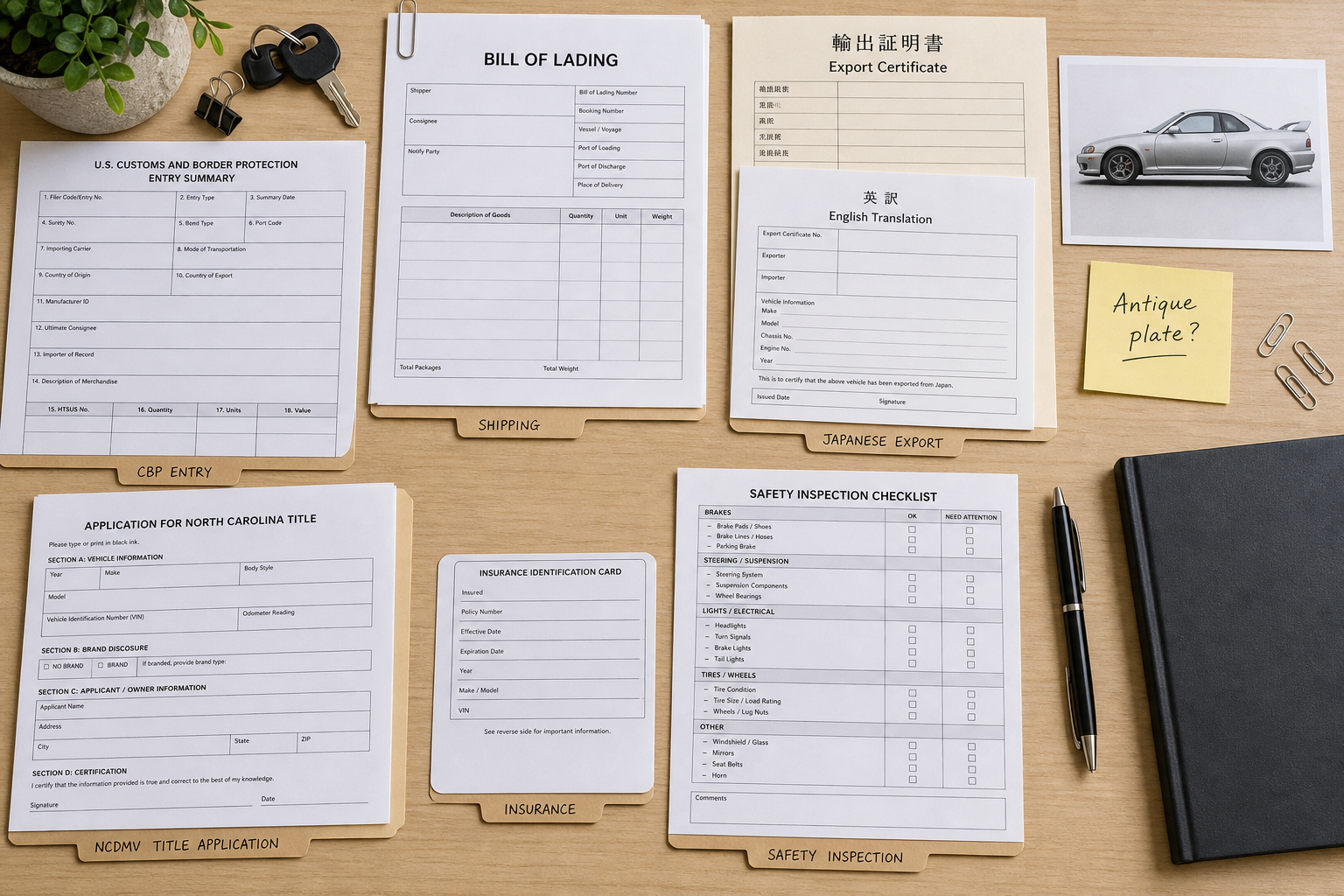
A practical North Carolina title packet usually includes:
- Japanese export certificate or foreign registration/deregistration document
- English translation for foreign-language ownership documents
- Bill of sale and invoice chain from seller/exporter to the North Carolina applicant
- Bill of lading and arrival documents
- CBP Form 7501 entry summary and any release/entry backup
- DOT Form HS-7
- EPA Form 3520-1 where used or required for the import file
- NCDMV Title Application, Form MVR-1
- Odometer disclosure if NCDMV requires it for the vehicle facts
- Damage disclosure if required
- Valid North Carolina driver license, temporary North Carolina driving certificate, or accepted out-of-state driver license when processing at a license plate agency
- North Carolina liability insurance if registration is requested
- Highway-use tax, property tax, title fee, registration fee, plate fee, and notary fee payment support
For most 25-year-old JDM cars, the odometer disclosure age rule may not be the main issue. The bigger issue is that the Japanese odometer reading is usually in kilometers. Keep the original kilometer reading and the mile conversion clear so the title file does not turn into math class at the counter.
CBP proof matters because DMV will not register a car without entry proof
CBP’s guidance on registering a foreign vehicle says that before a foreign vehicle can be registered in the United States, the owner must prove that an entry was filed with CBP. CBP also says the owner should keep DOT Form HS-7 and EPA Form 3520-1 because the DMV may ask for them, and that once entry is filed and duty is paid, CBP Form 7501 is proof the entry was filed.
That is why AWIS pushes customers to save the official Customs packet, not just the freight bill.
For North Carolina, the buyer should keep:
- CBP Form 7501 entry summary
- CBP release or entry backup where applicable
- Bill of lading
- Bill of sale or purchase invoice
- Foreign registration/export document
- DOT Form HS-7 showing the federal import basis
- EPA Form 3520-1 if part of the entry file
- Duty/payment backup if needed
If the buyer only has a broker worksheet or a port invoice, the license plate agency may not have enough to process the title. A worksheet is helpful for accounting. It is not proof that CBP accepted the vehicle entry.
North Carolina insurance must be from a North Carolina-licensed company
NCDMV says all vehicles with a valid North Carolina registration must have continuous liability insurance from a company licensed to do business in North Carolina. NCDMV also says out-of-state policies are not accepted.
That matters for JDM imports because some buyers try to insure the vehicle with a collector policy, specialty carrier, or out-of-state policy before the state title is finished. That may be fine for shipping or storage, but North Carolina registration requires an acceptable North Carolina policy.
Before the title appointment, confirm with the insurer that the vehicle can be covered using its Japanese chassis number or non-17-digit VIN if applicable. Do not wait until the car is sitting in the driveway to discover the policy system rejects the chassis number.
Safety inspection is still part of the North Carolina plan
NCDMV says a motor vehicle must pass an annual safety inspection before it can be registered in North Carolina or renewed. NCDMV also says an unregistered vehicle must be inspected before it can be registered, and that a 10-day temporary license plate may be issued to drive the vehicle for inspection and registration.
North Carolina safety inspection items include headlights, accessory lights, directional signals, foot brake, parking brake, steering, tires, horn, rearview mirror, windshield wipers, exhaust system, and emission control components.
For a JDM import, the practical safety inspection questions are usually simple but annoying:
- Do the headlights, brake lights, turn signals, hazard lights, and reverse lights work correctly?
- Are the tires DOT-marked and in acceptable condition?
- Are the windshield wipers and horn working?
- Is the exhaust safe and complete?
- Does the chassis number match the paperwork?
- Can the inspector enter the vehicle identity correctly if it does not have a U.S.-style 17-digit VIN?
- Is the vehicle old enough for an inspection exemption, or is the buyer using standard registration?
Right-hand drive alone is not the paperwork problem. Inconsistent identity numbers, lighting issues, old tires, missing documents, and inspection-station confusion are the usual problems.
Emissions rules depend on county, age, and vehicle type
North Carolina currently requires emissions inspection in 19 counties, performed with the annual safety inspection. NCDMV lists these emissions counties: Alamance, Buncombe, Cabarrus, Cumberland, Davidson, Durham, Forsyth, Franklin, Gaston, Guilford, Iredell, Johnston, Lincoln, Mecklenburg, New Hanover, Randolph, Rowan, Wake, and Union.
NCDMV also lists emissions exemptions for vehicles that are 20 years old or older, diesel-operated vehicles, farm vehicles, and certain newer low-mileage vehicles.
That is helpful for 25-year-old JDM imports. A federally legal 25-year-old gasoline JDM car should usually be older than North Carolina’s 20-year emissions cutoff. But do not turn that into a blanket promise. Confirm with NCDMV, NC DEQ, the inspection station, and the registration county before purchase, especially for kei trucks, diesel vehicles, unusual vehicle classes, swaps, or cars with incomplete paperwork.
Current NCDMV pages list 19 emissions counties. Some older NC DEQ materials refer to 22 counties from the prior program. Use the current NCDMV county list when planning, then verify before the appointment because inspection programs can change.
Antique plates are a 30-year conversation, not a 25-year import rule
North Carolina’s antique vehicle rule is different from the federal 25-year import rule.
NCDMV says antique vehicles are vehicles manufactured at least 30 years ago. Antique plates should be used for vehicles primarily used for exhibitions, club activities, parades, and other public interest events. NCDMV also says antique vehicles must be inspected and photographed by the N.C. State Highway Patrol when presented for first-time titling and registration.
NCDMV’s inspection pages add that vehicles more than 30 years old are exempt from annual safety inspection, and vehicles with antique automobile license plates are exempt from both annual safety and emissions inspections.
That can help some older JDM vehicles, but it is not a workaround for every import. A 1998 vehicle imported in 2026 may be federally eligible under the 25-year rule, but it is not automatically a North Carolina antique vehicle. For 2026, a vehicle generally needs to be manufactured in 1996 or earlier to be at least 30 years old, depending on the date details.
And antique plates should match real use. If the buyer plans to commute, use the vehicle as daily transportation, haul property, or run a work truck route, standard registration may be the cleaner discussion. Antique plates are for collector-style use, not a free pass for every JDM daily driver.
VIN and chassis number consistency is a common delay point
Many older Japanese-market vehicles do not have a 17-digit U.S.-style VIN. They may use a chassis number such as BNR32-012345, KZH106-0000000, or JA11-123456.
That can be manageable, but the paperwork needs to be consistent.
Before the North Carolina appointment, compare the vehicle identity number across:
- Japanese export certificate or deregistration document
- English translation
- Bill of sale
- Auction invoice or auction sheet, if available
- Bill of lading
- CBP Form 7501 and any entry backup
- DOT Form HS-7
- EPA Form 3520-1 if used
- Insurance documents
- Form MVR-1
- Inspection documents
Keep prefixes, hyphens, zeros, and model codes consistent where possible. If one document says BNR32-012345, another says BNR32012345, and a third drops the prefix completely, the vehicle may still be identifiable, but the state clerk should not have to play maritime archaeology with a Nissan chassis plate.
If the vehicle is missing a VIN/chassis plate, has a replacement plate, has conflicting identity numbers, or will be titled as an antique vehicle for the first time, contact NCDMV and the N.C. State Highway Patrol Investigative Services Unit before the vehicle is shipped or immediately after arrival.
Highway-use tax and property tax are separate from Customs duty
North Carolina generally collects highway-use tax when a title is transferred, instead of a normal vehicle sales tax. NCDMV also says vehicles are subject to property taxes collected through the state’s vehicle tax process on behalf of counties.
This is separate from Customs duty.
A JDM buyer may pay CBP duty based on the vehicle classification and value, then still owe North Carolina highway-use tax, property tax, title fees, registration fees, plate fees, and notary fees. The buyer should keep clean value support in case NCDMV, the county, or the insurer asks how the vehicle value was calculated.
Useful records include:
- Purchase invoice or bill of sale
- Auction invoice or auction sheet, if available
- Exporter invoice
- Payment proof if available
- CBP entry value
- Freight and landed-cost backup
- Translation of any value or ownership document written only in Japanese
Customs duty paid at the port does not settle the North Carolina title counter. Different bucket. Same vehicle.
Practical North Carolina packet for a 25-year-old JDM import
For a federally legal 25-year-old JDM import going into North Carolina, a practical packet should usually include:
- Japanese export certificate or foreign registration/deregistration document
- English translation of each foreign-language ownership document
- Bill of sale chain showing ownership transfer to the North Carolina applicant
- Purchase invoice and value support
- Bill of lading and shipping documents
- CBP Form 7501 entry summary
- Any CBP release or entry backup applicable to the shipment
- DOT Form HS-7
- EPA Form 3520-1 if used or required for the import file
- Proof the vehicle is at least 25 years old for federal import purposes
- Form MVR-1, notarized where required
- Odometer and damage disclosure paperwork if NCDMV requires it for the vehicle facts
- North Carolina insurance from a North Carolina-licensed company if registration is requested
- Safety inspection plan, or confirmation of any valid exemption
- Emissions county check, even if the vehicle should be age-exempt
- Highway-use tax, property tax, title fee, registration fee, plate fee, and notary payment support
- Antique plate plan only if the vehicle is at least 30 years old and the use fits NCDMV’s antique guidance
- N.C. State Highway Patrol inspection/photograph planning if presenting an antique vehicle for first-time title and registration
The exact packet can vary by vehicle age, vehicle type, owner facts, county, plate choice, insurance carrier, and how the license plate agency handles non-U.S. paperwork.
Common North Carolina JDM registration delays
The most common North Carolina delay points are avoidable:
- Buyer does not have the original foreign ownership/export document
- Japanese documents are not translated into English
- Bill of sale chain does not connect the seller/exporter to the North Carolina applicant
- Chassis number format changes across the Customs packet, ownership documents, insurance, and NCDMV forms
- Buyer has a broker invoice but not CBP Form 7501
- DOT HS-7 or EPA paperwork is missing from the file
- North Carolina insurance is not ready, or the carrier cannot write the policy using the chassis number
- Buyer does not plan for the annual safety inspection before registration
- Vehicle has old tires, lighting problems, exhaust issues, or basic safety failures
- Buyer assumes emissions testing applies because of the county, but does not check the 20-year age exemption
- Buyer assumes the 25-year federal rule equals North Carolina antique status, even though North Carolina antique status starts at 30 years
- Antique vehicle first-time title/registration is attempted without planning for N.C. State Highway Patrol inspection and photos
- Highway-use tax, property tax, and value support are not ready
- Kei trucks, vans, or unusual vehicle classes are treated like ordinary passenger cars without checking NCDMV handling first
Most of this can be fixed before the vehicle ships. After arrival, every missing document becomes a scavenger hunt with a temporary tag clock running.
Should North Carolina buyers import JDM vehicles?
Often, yes. North Carolina can be a practical state for 25-year-old JDM imports if the buyer prepares the file correctly and checks inspection, insurance, and plate questions before arrival.
A North Carolina JDM import may make sense if:
- The vehicle is federally legal under the 25-year rule
- The Japanese export or registration document is clean
- English translations are ready
- The bill of sale chain is complete
- CBP entry and release paperwork is saved
- DOT HS-7 and EPA paperwork are handled correctly
- The chassis number is consistent everywhere
- North Carolina insurance is confirmed before registration
- The safety inspection path is understood
- Emissions county rules and the 20-year exemption are checked
- Antique plate use is only considered for vehicles at least 30 years old and used like collector vehicles
- Highway-use tax, property tax, and value support are ready
It may not make sense if the seller cannot prove ownership, the chassis number trail is messy, the buyer cannot get translations, the vehicle is not federally eligible, the buyer expects a 25-year import to be treated as a North Carolina antique automatically, or the insurance/inspection path has not been checked.
Bottom line
North Carolina is not the harshest state for 25-year-old JDM imports, but it still has state-specific traps.
The North Carolina handoff usually comes down to clean Customs paperwork, original foreign ownership documents, English translations, Form MVR-1, North Carolina insurance, safety inspection planning, emissions county awareness, the 20-year emissions exemption, highway-use tax, property tax, and the separate 30-year antique vehicle rules.
AWIS can help with the Customs side of a JDM import, including entry planning, CBP paperwork coordination, duty, EPA/DOT documentation, and release planning. For North Carolina title, registration, insurance, inspection, emissions, taxes, and plate decisions, confirm current requirements directly with NCDMV, the selected license plate agency, NC DEQ where emissions questions apply, the N.C. State Highway Patrol Investigative Services Unit when needed, and the buyer’s insurance provider before purchase or arrival.
This article is general information, not legal advice. North Carolina requirements can change, NCDMV handling can vary, and title, tax, insurance, inspection, emissions, and plate rules can depend on model year, fuel type, GVWR, vehicle classification, owner facts, county, documents, inspection station, and intended use. Confirm requirements directly before purchase.
Sources reviewed
- NCDMV, Vehicle Documents & Forms
- NCDMV, Vehicle Emissions & Safety Inspections
- NCDMV, Vehicle Emission Inspection
- NCDMV, Vehicle Safety Inspection
- NCDMV, Other Vehicle Types to Title and Register
- NCDMV, Vehicle Insurance Requirements
- NCDMV, Vehicle Taxes
- NCDMV, Vehicle Title & Registration Fees
- NC DEQ, Emissions Inspections Exempt 20-Year-Old Vehicles Starting Dec. 1
- U.S. Customs and Border Protection, Importing a Motor Vehicle
- CBP Help, Registering a foreign vehicle or motorcycle with the Department of Motor Vehicles
- NHTSA, Importation and Certification FAQs