Section 122 duties expired at 12:01 a.m. EDT on July 24, 2026. The replacement conversation is now the new Section 301 forced-labor tariff framework covering 60 U.S. trading partners, with product exemptions and country-specific rate treatment.
For AWIS customers, the important question is not “what is the new universal car tariff?” There is not one safe answer. The answer depends on the vehicle or part, its country of origin, HTS classification, Chapter 99 reporting, entry date, whether Section 232 already applies, and whether a specific exemption or preference program applies.
Here is the practical broker-level version for importers looking at classics, JDM vehicles, European vehicles, Canadian purchases, parts, accessories, motorcycles, project cars, and commercial inventory.
What actually changed after July 24
Before July 24, many importers were watching the temporary Section 122 layer. After July 24, Section 122 is no longer the layer to rely on for new entries. USTR’s final Section 301 action now applies a 10% or 12.5% additional duty to most imports from covered economies, subject to exemptions in the Federal Register notice.
USTR’s fact sheet says the action covers the top 60 U.S. trade partners and applies to most imports from covered countries. It also states that goods subject to Section 232 tariffs, informational materials, donations, accompanied baggage, and certain exempt product lists are not covered by this action.
That matters for vehicle importers because automobiles and auto parts can already have their own tariff treatment. CBP’s auto tariff FAQs state that used passenger vehicles and trucks are subject to Section 232 duties except those manufactured in a year at least 25 years before the year of entry. In plain English: a newer vehicle that is legally admissible may be in a different tariff lane than a 25-year classic.
Country-by-country implications importers should check
These are planning notes, not final duty quotes. AWIS still needs the VIN/build date, invoice, bill of lading, origin support, HTS classification, and intended entry date before giving entry-specific guidance.
United Kingdom
The UK is reported in the final Section 301 framework as a 10% economy, with UK-specific exemption lists in the Federal Register package. For customers importing classic Land Rovers, Minis, Defenders, motorcycles, parts, or specialty vehicles, the practical question is whether the item is a 25-year vehicle, a part/accessory, or something already covered by another tariff program.
Examples:
- UK-origin 1995 Mini Cooper classified as a passenger vehicle: 2.5% passenger vehicle duty + possible 10% Section 301 additional duty unless an exemption applies.
- UK-origin Land Rover Defender in passenger/SUV configuration: 2.5% passenger vehicle duty + possible 10% Section 301 additional duty.
- UK-origin Defender pickup or cargo/commercial configuration: could be 25% truck duty + possible 10% Section 301 additional duty.
A UK-origin 25-year classic may avoid the newer-vehicle Section 232 auto duty path, but that does not automatically mean the entry is duty-free. The broker still has to review the Section 301 Chapter 99 reporting and any UK-specific product exemption before you wire money or load the vehicle.
European Union and Germany
The EU is treated differently than a simple flat-rate country in the final framework. Global Trade Alert’s review of the Federal Register package reports EU treatment at 10% applied net of the product’s MFN duty, plus EU-specific exemption lists.
For Germany, that means a Porsche, Mercedes-Benz, BMW, Volkswagen, Audi, motorcycle, engine, gearbox, body shell, or parts shipment should be reviewed as EU-origin, not just “shipped from Germany.” Origin matters. A German-sold vehicle that was built outside the EU, or parts consolidated through a German warehouse, may not get the same result as EU-origin goods.
Examples:
- German-origin 1998 Porsche 911 classified as a passenger vehicle: 2.5% passenger vehicle duty + EU Section 301 treatment, reviewed against the final EU formula and exemptions.
- German-origin Mercedes Sprinter, pickup, or cargo-style vehicle: could be 25% truck duty + EU Section 301 treatment, depending on classification and configuration.
- German-origin BMW engine, gearbox, body panel, or other auto part: the base duty depends on the exact HTS line. Many common auto parts are around 2.5%, but some are different, then the broker checks whether the EU Section 301 layer applies.
Before buying, confirm country of manufacture/origin, build date, complete vehicle versus parts status, and whether the HTS line falls inside a product exemption.
Japan
Japan is especially relevant for AWIS customers importing JDM vehicles. Global Trade Alert reports Japan in the 12.5% net-of-MFN treatment group.
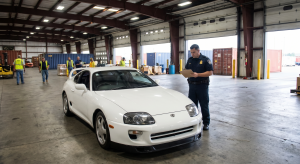
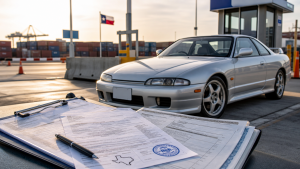
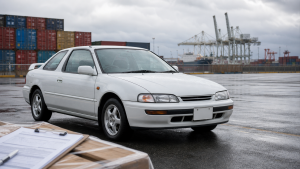
The key practical point: the 25-year EPA/DOT path did not disappear. A vehicle at least 25 years old can still use the classic import path for DOT/EPA purposes when the documents support it. But the 25-year rule is an admissibility path; it is not a blanket duty exemption. A 25-year Skyline, Land Cruiser, kei truck, HiAce, Supra, or motorcycle still needs HTS classification, origin review, Chapter 99 review, and a landed-cost estimate before shipment.
Examples:
- Japan-origin 1998 Nissan Skyline, Supra, RX-7, or other passenger car: 2.5% passenger vehicle duty + possible 12.5% Section 301 additional duty.
- Japan-origin kei truck, HiAce cargo van, Land Cruiser pickup, or other truck/cargo classification: could be 25% truck duty + possible 12.5% Section 301 additional duty.
- Japan-origin motorcycle: motorcycle duty often ranges from 0% to 2.4%, depending on engine size and HTS classification, plus possible 12.5% Section 301 additional duty.
Also check parts separately. Engines, transmissions, wheels, body panels, and accessories may not follow the same duty logic as a complete vehicle.
Canada
Canada is reported as a 10% economy, but Canada has an important USMCA wrinkle. USTR and trade advisories note that goods of Canada and Mexico entered duty-free under USMCA may be exempt from the new forced-labor Section 301 duty.
Do not assume every car bought in Canada is “Canadian origin.” A vehicle purchased from a Canadian seller may have been manufactured in Japan, Germany, the UK, Korea, the United States, Mexico, or elsewhere. For Canada-to-U.S. purchases, AWIS needs the VIN, manufacturer/build information, invoice, registration/title history, and any USMCA support before treating it as preferential.
Examples:
- Canada-origin passenger vehicle with valid USMCA support: potentially 0% duty under USMCA and may avoid the new Section 301 layer if the entry qualifies.
- Canada-origin truck with valid USMCA support: potentially 0% duty under USMCA instead of the standard 25% truck duty, if the documentation supports the claim.
- JDM car purchased from a Canadian seller but manufactured in Japan: generally not Canada-origin. Treat it as Japan-origin for review, such as 2.5% passenger vehicle duty + possible 12.5% Section 301 additional duty.
This is especially important for classics and enthusiast vehicles that were imported into Canada first and are later resold to a U.S. buyer.
South Korea
South Korea is reported with Japan and Switzerland in the 12.5% net-of-MFN treatment group. For importers looking at Hyundai, Kia, Genesis, Korean-market vehicles, motorcycles, or parts, the practical issue is not just the sale country. It is the product’s origin, classification, and whether another tariff program or exemption applies.
Examples:
- South Korea-origin passenger vehicle that is admissible for import: 2.5% passenger vehicle duty + possible 12.5% Section 301 additional duty.
- South Korea-origin pickup, cargo van, or truck-style vehicle: could be 25% truck duty + possible 12.5% Section 301 additional duty.
- South Korea-origin Hyundai/Kia/Genesis parts: base duty depends on the part’s HTS classification. Many common auto parts are around 2.5%, then the broker checks whether the 12.5% Section 301 layer applies.
If the vehicle is not yet 25 years old, DOT/EPA admissibility may be the bigger blocker than duty. If it is 25 years old or otherwise admissible, the broker still needs to calculate the duty stack before entry.
Australia and New Zealand
Australia and New Zealand are included among the 60 covered economies and, based on the public Federal Register summaries, fall in the 12.5% flat-rate group unless a product exemption applies.
Examples:
- Australia-origin Holden/HSV passenger vehicle: 2.5% passenger vehicle duty + possible 12.5% Section 301 additional duty.
- Australia-origin ute, pickup, or cargo-style vehicle: could be 25% truck duty + possible 12.5% Section 301 additional duty.
- New Zealand-origin specialty vehicle, trailer, equipment, or parts shipment: duty depends on the exact HTS line. A passenger vehicle may be 2.5%, a truck may be 25%, motorcycle duty often ranges from 0% to 2.4%, and the Section 301 layer may still need review.
- Land Cruiser, Skyline, HiAce, Defender, or European classic purchased in Australia or New Zealand but manufactured somewhere else: duty follows origin, not seller location. A Japan-origin vehicle still needs Japan-origin treatment; a UK-origin vehicle still needs UK-origin treatment.
For customers importing Land Cruisers, Holden/HSV vehicles, utes, motorcycles, right-hand-drive classics, performance parts, or specialty equipment, the same rule applies: confirm origin and age before shipping. A vehicle purchased in Australia or New Zealand may not be Australian- or New Zealand-origin if it was originally built in Japan, Europe, Korea, Thailand, or another country.
What did not change for vehicle importers
The tariff change did not replace the normal vehicle import process. Importers still have to satisfy the same core requirements that caused problems before July 24.
- The 25-year DOT path still depends on the vehicle’s age and supporting HS-7 documentation.
- EPA requirements and EPA Form 3520-1 still apply.
- CBP entry still has to be filed correctly; CBP officers do not act as the importer’s broker.
- HTS classification still controls the duty calculation.
- Country of origin still matters more than the country where you bought the vehicle.
- The importer of record still needs proper identity, bond when required, and power of attorney for the broker.
- Ocean shipments still require ISF filing when applicable, generally before loading.
- USDA cleanliness rules still matter; the undercarriage should be clean before shipment.
- State title, emissions, inspection, and registration rules still happen after federal import clearance and can vary widely.
A tariff update does not make a nonconforming vehicle admissible. It also does not solve state registration.

What to check before buying, wiring funds, or shipping
Before you send money overseas, ask for the documents and facts that let a licensed customs broker review the entry before the vehicle moves.
- VIN or chassis number, build month/year, make, model, body type, and engine details.
- Country of manufacture/origin, not only seller location or port of export.
- Commercial invoice, auction sheet, bill of sale, and foreign title/registration when available.
- Whether the import is a complete vehicle, parts shipment, engine, half-cut, motorcycle, trailer, or equipment.
- Intended U.S. port, vessel schedule, bill of lading timing, and expected entry date.
- DOT HS-7 and EPA 3520-1 eligibility path.
- HTS classification and any required Chapter 99 numbers.
- Whether Section 232, Section 301, USMCA, AD/CVD, or a product exemption may apply.
- Importer of record, bond, and broker power of attorney.
- State registration plan after customs release.
If the seller cannot provide origin, build date, or title/export documents, treat that as a customs risk before you wire funds.
Broker takeaway
Section 122 expired. The new Section 301 framework is more country- and product-specific than a simple replacement surcharge. For AWIS customers, the useful answer is a pre-purchase duty and admissibility review by country, product, age, origin, and entry timing.
If you are importing from the UK, Germany or the EU, Japan, Canada, South Korea, Australia, or New Zealand, send AWIS the documents before the vehicle or parts ship. The right review can prevent a landed-cost surprise, a delayed entry, or a vehicle that clears customs but becomes difficult to title later.
Sources checked July 28, 2026: USTR July 2026 Section 301 forced-labor fact sheet and Federal Register notice reference; Global Trade Alert review of the final Section 301 forced-labor action and economy treatments; CBP Importing a Motor Vehicle guidance; CBP Section 232 Additional FAQs for Automobiles and Auto Parts; CBP personal vehicle/import guidance and ISF timing guidance from prior AWIS source files.