
There is not one single “July 2026 auto tariff deadline” that applies to every private vehicle importer. That matters. If someone is telling you every imported car has the same July deadline, ask what notice, HTS provision, proclamation, or CBP instruction they are relying on.
What July does have is a live tariff environment. Section 232 auto and auto-parts measures remain active, Commerce has July 2026 activity tied to the parts tariff offset program, CBP trade-remedy guidance is still the place to check implementation details, and vehicle entries still turn on the basics: HTS classification, country of origin, entry timing, EPA/DOT admissibility, bond, POA, and ISF data.
The practical AWIS answer is simple: review the customs treatment before the car ships. Once the vehicle is on the water, your options narrow and the storage clock is not known for its mercy.
This guide is general information for vehicle importers. Tariff rules, exclusions, CBP instructions, and agency requirements can change. Before buying or shipping a vehicle, verify the current treatment with a licensed customs broker and, when needed, CBP.
The July 2026 watch items, not fake deadlines
As of July 15, 2026, the key point is that we did not verify a universal July deadline for all vehicle imports. The current watch items are:
- Section 232 auto and auto-parts tariff exposure for covered vehicles and parts
- Commerce’s June 16, 2026 Federal Register notice on the Parts Tariff Offset Program, with comments due within 30 days of publication
- CBP trade-remedies guidance and any updated implementation instructions
- HTS Chapter 87 classification and any Chapter 99 tariff numbers that apply
- Country-of-origin support, especially where the vehicle shipped from one country but was built in another
- ISF timing for ocean shipments
- EPA Form 3520-1 and DOT/NHTSA HS-7 eligibility before arrival
The Commerce offset-program item is mainly relevant to manufacturers and authorized importers of covered parts, not a blanket deadline for a private person importing one car. Still, it confirms the auto tariff environment is active in July 2026.
1. Confirm the HTS classification before quoting landed cost
The HTS classification drives the duty rate and determines whether additional tariff provisions may apply. Do not rely only on the seller’s description or auction listing.
At minimum, confirm:
- Vehicle type: passenger car, SUV, truck, van, motorcycle, bus, tractor, trailer, or equipment
- Fuel type: gas, diesel, hybrid, electric, or other propulsion
- Engine size or motor type where relevant
- Gross vehicle weight where relevant
- New or used status
- Model year and build date
- Whether the vehicle is complete, incomplete, modified, or part of a larger shipment
CBP’s general motor vehicle guidance still lists foreign-made vehicles as generally dutiable at 2.5% for autos, 25% for trucks, and 2.4% or free for motorcycles, based on the price paid or payable. That is the starting point, not always the final landed cost.
For July 2026 entries, classification also matters because Section 232 auto measures and other trade-remedy provisions may sit on top of the regular duty analysis.
2. Check whether Section 232 auto tariffs apply
CBP’s Section 232 auto FAQ says commercial vehicles such as sedans, SUVs, crossover utility vehicles, minivans, cargo vans, and light trucks provided for in heading 9903.94.01, HTSUS, are subject to Section 232 duties under the applicable proclamation.
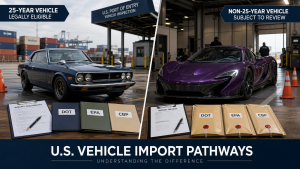
CBP also states that used passenger vehicles and trucks are subject to Section 232 duties, except those manufactured in a year at least 25 years prior to the year of entry.
That 25-year point matters for JDM and classic imports. A 2001 vehicle entered in 2026 may be outside the Section 232 auto duty based on CBP’s FAQ, but that does not automatically mean the entry is duty-free. Normal duty, other tariff provisions, EPA/DOT rules, and document requirements may still apply.
For light trucks, CBP specifically identifies subheadings including 8704.21.01, 8704.31.01, 8704.41.00, 8704.51.00, and 8704.60.00 as subject to the duties. If the vehicle is arguably a truck, do not guess. Classification needs to be settled before the importer wires money overseas.
3. Watch the parts tariff offset program, but do not confuse it with a private importer deadline
The Federal Register notice published June 16, 2026 for the Parts Tariff Offset Program says Proclamation 10908 imposed a 25% tariff on certain automobile imports effective April 3, 2025, and certain automobile parts effective May 3, 2025.
The same notice describes an offset program for automobile and medium/heavy-duty vehicle manufacturers with final production in the United States. The comment period is a July 2026 watch item, but it is not the same as a deadline for every private vehicle importer to enter a car by a certain day.
For individual importers, the safer question is not “what is the July deadline?” It is “what tariff treatment applies to my exact vehicle on the date of entry?”
4. Verify country of origin, not just where the vehicle ships from
Country of origin is not always the port of export. A vehicle shipped from Japan may not have Japanese origin. A vehicle bought in Europe may have been built somewhere else. A truck purchased from Canada or Mexico may not qualify for preferential treatment just because it crossed a North American border.
Before shipment, collect proof of origin where possible:
- Manufacturer build plate or VIN information
- Foreign registration or title
- Bill of sale and purchase documents
- Export certificate or deregistration document
- Manufacturer statement or other support when needed
- Any USMCA certification claim, if someone is asserting preferential treatment
CBP’s vehicle import guidance notes that USMCA eligibility for vehicles is strict and depends on automotive rules of origin. For older used vehicles, do not assume USMCA duty-free treatment applies.
5. Estimate the full duty and tariff exposure before the unit loads
The importer should understand the total exposure before the vehicle is delivered to the foreign port.
That means checking:
- Base duty under the HTS classification
- Section 232 auto or truck tariff exposure
- Whether any reciprocal tariff, exclusion rule, or Chapter 99 number affects the entry
- Whether Chapter 98 or other special treatment may apply
- Merchandise Processing Fee and Harbor Maintenance Fee where applicable
- Bond amount and whether a single transaction bond or continuous bond is better
- Port, exam, storage, demurrage, and broker/forwarder costs
CBP’s trade remedies page and official notices should be checked close to entry because trade remedies can change by proclamation, Federal Register notice, CSMS message, or updated HTS instruction.
6. Have the CBP entry documents ready early
For CBP clearance, the usual vehicle entry file should include:
- Ocean bill of lading or arrival notice
- Bill of sale or commercial invoice
- Foreign title, registration, export certificate, or deregistration document
- VIN, year, make, model, and vehicle description
- Purchase price and currency support
- Importer ID information
- Signed customs power of attorney
- Customs bond information
- EPA Form 3520-1 where required
- DOT/NHTSA Form HS-7 where required
- Any exemption, eligibility, or agency support documents
For ocean shipments, Importer Security Filing also matters. CBP states that ISF is generally due no later than 24 hours before cargo is loaded on the vessel bound for the United States. CBP also warns that inaccurate, incomplete, or late ISF can trigger liquidated damages of $5,000 per violation.
That is not a paperwork detail to handle “once the car gets here.” For ocean vehicle imports, the broker or filing party needs the right seller, buyer, importer, consignee, manufacturer/supplier, ship-to party, country of origin, and HTS data early.
7. Do not ignore EPA and DOT/NHTSA forms
Customs clearance is not only a duty payment problem.
CBP’s vehicle import guidance says importers must complete EPA Form 3520-1 and DOT Form HS-7, declaring the emissions and safety provisions under which the vehicle is imported. EPA’s current forms page says Form 3520-1 is used for passenger vehicles, highway motorcycles, and corresponding engines. EPA Form 3520-21 is used for heavy-duty highway engines and nonroad engines, including engines already installed in vehicles or equipment.
NHTSA’s HS-7 declaration is tied to Federal Motor Vehicle Safety Standards, bumper standards, and theft prevention standards. NHTSA warns that failure to provide required information can result in refusal of entry, and false declarations can carry penalties.
If a seller says “no problem, everyone imports these,” verify it. Especially on newer nonconforming vehicles, kit cars, mini-trucks, off-road equipment, heavy trucks, and modified vehicles.
8. Make sure the importer, bond, and POA match the real transaction
The importer of record is responsible for the entry. Before shipment, confirm:
- The legal importer name
- EIN, SSN, or CBP-assigned number where applicable
- Mailing address and contact details
- Whether the importer is an individual or business
- Whether a continuous bond already exists
- Whether the broker has a valid POA
- Whether the invoice buyer matches the intended importer
A mismatch can delay clearance. If a business bought the vehicle but an individual tries to enter it, or if the broker cannot validate the importer number, the car may sit while everyone trades PDFs and mild regret.
9. Questions to ask before the car ships
Before the vehicle ships, importers should ask their broker:
- What HTS classification are we using, and why?
- What country-of-origin support do we have?
- What is the estimated base duty?
- Does Section 232 apply?
- Are any reciprocal tariff provisions, exclusions, or Chapter 99 numbers relevant?
- Do EPA and DOT forms support this import?
- Is an ISF required, and who is filing it?
- What bond is needed?
- What documents are missing before loading?
- What could change before entry?
If the answer is “we’ll figure it out when it arrives,” that is not a plan. That is a storage bill warming up.
Bottom line
For July 2026, importers should treat auto tariffs as a live watch item, not a one-size-fits-all deadline. Confirm classification, origin, Section 232 exposure, regular duty, agency forms, bond, POA, importer details, and ISF data before the vehicle leaves the foreign port.
AWIS helps importers review vehicle entry requirements, organize customs documents, and identify duty and tariff questions before the car ships.
If you are importing a vehicle, send the year, make, model, VIN, country of manufacture, purchase invoice, foreign registration/export document, and expected port of arrival before booking the sailing.
Sources checked
- U.S. Customs and Border Protection: Importing a Motor Vehicle
- U.S. Customs and Border Protection: Section 232 Additional FAQs – Automobiles and Auto Parts
- U.S. Customs and Border Protection: Trade Remedies
- Federal Register, June 16, 2026: Parts Tariff Offset Program for Automobiles, MHDVs, and Engines
- International Trade Administration: Automotive Motor Vehicle Tariff Codes
- International Trade Administration: Automotive Parts Tariff Codes
- EPA: Publications and Forms for Importing Vehicles and Engines
- NHTSA: Importing a Vehicle / HS-7 declaration information
- CBP Help: Import Security Filing timing and data requirements